Answering the most common buyer question: which bilge pump is best for your boat depends on your boat size, typical water exposure, and whether you want automatic protection or manual control. This guide highlights five reliable options, explaining who each is best for, plus practical pros and limitations. Ideal for boat owners, captains, and DIY marine enthusiasts seeking dependable water removal.
Quick comparison table of selected products:
| Product | Flow (GPH) | Voltage | Outlet | ||
|---|---|---|---|---|---|
| SEAFLO 06 Series Automatic Submersible Bilge Pump | 750 | 12V | 3/4″ | Automatic Float | |
| MAXZONE 12V 1100GPH Auto Pump | 1100 | 12V | 1-1/8″ | Built-in Float | |
| FILTERUP 1100 GPH Auto Kit | 1100 | 12V | 1-1/8″ | Automatic (reed sensor) | |
| Subtoy 1100GPH With Built-In Float | 1100 | 12V | 1-1/8″ | Automatic Float | |
| SEAFLO 2000 GPH Anti-Airlock Pump | 2000 | 12V | 1-1/8″ | Automatic Float |
SEAFLO 06 Series Automatic Submersible Bilge Pump

The SEAFLO 06 Series is a compact, all-in-one bilge pump with a 750 GPH flow rate and a built-in float switch. Its 3/4″ outlet fits common marine hoses, and the 4-year warranty signals a focus on reliability. This model is best for smaller to mid-sized boats that require automatic bilge protection without additional components. The integrated float switch activates at about 1.6 to 2 inches of water and shuts off when the bilge dries, helping conserve battery power. A potential limitation is that 750 GPH may be insufficient for larger vessels in heavy rain or rough seas, making it better suited for standard daily use or smaller craft.
Best for: Smaller boats, day boats, or boats where space and simplicity matter. It is a strong pick for users who want a straightforward, automatic bilge solution without extra accessories.
MAXZONE 12V 1100GPH Auto Pump

The MAXZONE unit delivers 1100 GPH with a built-in float switch, eliminating the need for a separate sensor. Its compact footprint and 1-1/8″ outlet width make it compatible with many hull fittings. This pump is best for mid-sized boats that require reliable automatic operation and a straightforward install. The built-in float reduces clutter, but users should verify that the 1 m wiring and included hose kit align with their setup. It may not handle extreme pumping scenarios as rapidly as higher-capacity models.
Best for: Boats that need a reliable automatic pump with a bundled float switch and a compact form factor for easy installation.
FILTERUP 1100 GPH Auto Kit

The FILTERUP kit combines an 1100 GPH automatic pump with a complete installation package, including hoses, clamps, and a thru-hull fitting. It suits boat owners who want an all-in-one solution that minimizes extra shopping. The built-in reed sensor system ensures fully automatic operation, reducing manual intervention. A potential drawback is that, while the kit is convenient, there is still a need to ensure compatibility with your boat’s hull fittings and electrical system before purchase.
Best for: Do-it-yourselfers seeking an end-to-end installation kit with automatic bilge pumping capability.
Subtoy 1100GPH Auto Kit With Built-In Float
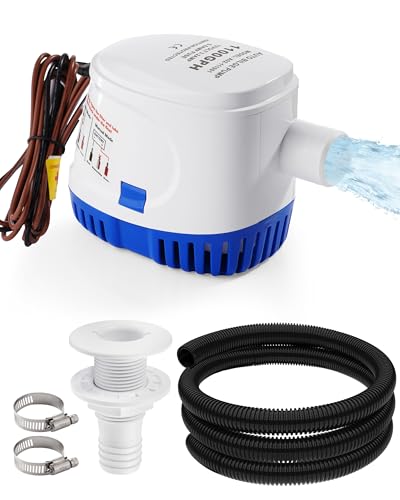
The Subtoy unit provides 1100 GPH and includes a built-in float switch for automatic operation. Its compact design makes it suitable for fishing boats, runabouts, and yachts where space is at a premium. The model emphasizes quick water removal and straightforward wiring. A limitation to note is that 1100 GPH may not be sufficient for extreme flooding scenarios on larger vessels, so pairing with a secondary pump can be prudent for redundancy.
Best for: Boats needing a dependable automatic pump with simple, ready-to-install components for faster setup.
SEAFLO 2000 GPH Anti-Airlock Pump

The SEAFLO 01 Series offers 2000 GPH flow with anti-airlock protection and a 1-1/8″ outlet. This model targets larger boats or those that regularly encounter heavy bilge water scenarios. A 4-year warranty supports durable performance expectations. It is best for bigger vessels or situations where rapid bilge removal is essential. The higher current draw and headroom should be checked against the vessel’s power capacity to avoid battery strain or wiring concerns.
Best for: Larger boats or high-water events where fast drainage is critical and electrical capacity supports higher current draw.
Buying Guide: Key Considerations For Choosing A Bilge Pump
- Boat size and typical water exposure: Larger boats or saltwater environments benefit from higher GPH pumps and robust corrosion resistance. Smaller boats can rely on lower GPH models with automatic protection.
- Automatic vs manual: Automatic pumps with integrated float switches reduce the need for supervision, ideal for unattended operation. Manual pumps provide direct control but require monitoring.
- Outlet size and hose compatibility: Ensure the pump outlet matches your bilge hose or through-hull fittings to avoid adapters that can leak or reduce flow.
- Power requirements: Confirm the boat’s electrical capacity supports the pump’s current draw, especially for high-GPH units.
- Durability and warranty: A longer warranty can indicate reliability but verify warranty terms and what is covered (defects vs. wear).
- Installation kit: Some models include hoses, clamps, and fittings, which speeds up installation and reduces missing parts.
- Maintenance considerations: Look for features like anti-airlock protection and easy access for cleaning and maintenance.
FAQ
- What is a typical bilge pump flow rate I should choose? Choose based on your vessel size and expected water load. Smaller boats may be fine with 750–1100 GPH, while larger boats or frequent heavy seas may require 1100–2000 GPH or more.
- Do I need a separate float switch? No, many models include a built-in float switch for automatic operation, reducing wiring complexity.
- Is a higher GPH always better? Not always. Higher GPH draws more current and may be unnecessary for small bilges. Match capacity to your needs and power capacity.
- Can these pumps be used for freshwater and saltwater? Yes, most marine bilge pumps are designed to tolerate both environments, but check corrosion resistance and materials for saltwater exposure.
- Should I add a second pump for redundancy? For critical applications or high-risk areas, a second pump provides redundancy in case one fails or clogs.
- What maintenance is required? Regularly inspect the inlet and strainer, test automatic operation, and clean debris to prevent clogging and reduce wear.