Answering the question “which beach anchors for boats work best?” this article compares five top options for shoreline docking, sandbars, and shallow-water anchors. Suited buyers include jet ski owners, pontoon crews, kayakers, and small-boat operators who need reliable grip in sand or shallow reefs. Below you’ll find concise product insights, why each was selected, and how they fit different boating setups. A quick buying table at the start helps you compare at a glance.
| Product | Best For | Notes |
|---|---|---|
| BeneLabel 17″ Sand Bar Anchor | Shallow or sandy beaches; portable use | Lightweight stainless steel, includes storage bag |
| VEVOR Sand Spike Boat Anchor Pole | Small boats and jetskis in soft sand | Self-hammering, long spike, dual tie-down loops |
| SandShark Supersport 3.0 | Jet skis, pontoons at beaches and sandbars | Reinforced nylon and aluminum; compact case |
| Venussar 39″ Sand Spike | Shallow water shorelines and sandbars | Hot-dipped galvanized steel; 50 ft line |
| Better Boat Sand Spike | Large and small boats; quick setup | Hot-dipped galvanized steel; 30 ft rope included |
BeneLabel 17″ Sand Bar Anchor

Best for: Beachgoers and small watercraft in shallow, sandy areas. The anchor is made from 304 stainless steel for seawater resistance and impact durability, ideal for beaches, sandbars, or shoreline docking. Its 17-inch length and propeller-style design improve grip in soft sand with straightforward screw-in action.
Why selected: The combination of corrosion resistance and compact portability makes it a user-friendly option for quick deploy-and-hide scenarios. Includes a storage bag for easy transport.
Caution: It weighs about 1.28 pounds, which may limit holding power in stronger currents or very windy conditions; consider larger anchors for heavier boats or rougher seas.
VEVOR Sand Spike Boat Anchor Pole

Best for: Small boats and jetskis operating in soft, sandy shoreline zones without rocks or heavy silt. The 38.8-inch long spike with a lower 21.6-inch section provides deep insertion for stability in shallow water.
Why selected: Self-hammering design speeds setup, and two tie-down loops handle dock lines or ropes with flexibility. Its longer spike helps anchor in soft substrates where shorter spikes struggle.
Limitations: Heavier at about 9.5 pounds, so transport may require a dedicated bag or cart, especially for multi-boat setups.
SandShark Supersport 3.0 Boat Anchor

Best for: Jet skis, pontoons, and beach setups where you need strong hold in shallow water and sandbars. The anchor kit emphasizes preventing beach or watercraft impact by keeping vessels tethered securely offshore.
Why selected: Reinforced nylon, engineering-grade plastic, and aircraft-grade aluminum provide robust construction with collapsible handles for compact storage. Includes a padded case for transport.
Limitation: Made with composite materials rather than pure metal, which may influence long-term wear in salt-heavy environments; ensure periodic inspection for wear points.
Venussar 39″ Sand Spike Boat Anchor Pole

Best for: Shallow-water shorelines and sandbars where a longer spike provides extra leverage for secure anchoring. The 39-inch design supports deeper penetration in soft or compacted sand and rocks with reduced drift risk.
Why selected: Hot-dipped galvanized steel offers corrosion resistance in both salt and freshwater, and the 50-foot anchor line provides flexibility for varying docking distances.
Caution: Larger footprint means heavier weight; ensure vehicle or storage space accommodates the longer pole and line when not in use.
Better Boat 30 Ft Sand Spike Pole System
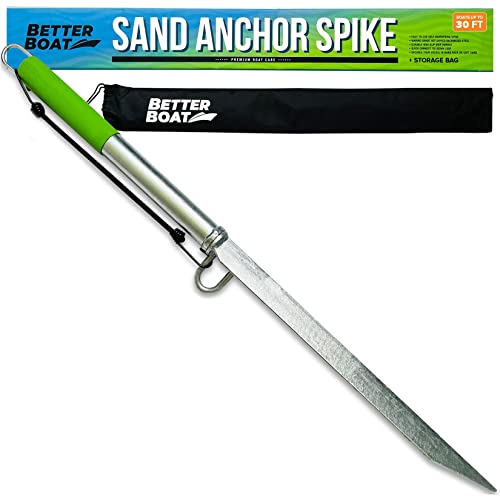
Best for: Versatile anchoring for boats of various sizes, from kayaks to bigger pontoons, especially where quick setup matters in shallow water.
Why selected: The bungee-assisted self-hammering design drives the spike deeper without tools, and the hot-dipped galvanized steel provides saltwater durability. Includes a 30-foot rope compatible with common dock lines.
Limitation: The system relies on a single spike anchor; in very high currents or strong winds, pairing with additional lines or anchors could improve security.
Buying Guide: Key Considerations For Beach Anchors
- Material and corrosion resistance: Stainless steel offers strong seawater resistance, while galvanized steel provides a cost-to-durability balance for mixed water environments.
- Anchor length and weight: Longer spikes penetrate deeper, ideal for soft sand, but heavier units require more storage and transport effort.
- Ease of deployment: Self-hammering or screw-in designs reduce setup time; check whether a tool-free option exists.
- Boat size compatibility: Match anchor capacity to boat length and weight; smaller craft need lighter, easier-to-handle options.
- Line length and docking compatibility: Ensure the included rope length fits your typical docking distance and dock-line sizes.
- Portability vs. stability: Lighter anchors are easy to carry, but heavier, longer spikes provide steadier holds in challenging shorelines.
- Storage and transport: Storage bags and compact forms help keep gear organized for shore launches and transport.
FAQ
- What type of anchor is best for sandy beaches?
Answer: A lightweight, corrosion-resistant screw-in or spike anchor with a long spike for deep sand penetration works well on sandy beaches. - Do I need a long anchor for shallow water?
Answer: Not always, but a longer spike can improve stability in soft substrates and reduce drift in tidal zones. - Should I buy a complete rope and anchor line with the anchor?
Answer: A matching line length (commonly 30–50 ft) is recommended to reach typical docking points and allow proper tensioning. - Can I use these anchors for larger boats?
Answer: Some anchors are intended for small boats and jetskis; verify the product’s stated load capacity before use with larger vessels. - Is self-hammering better than manual driving?
Answer: Self-hammering designs speed deployment and reduce effort, but ensure the ground is suitable to avoid damage to the spike or handle. - How should I store beach anchors when not in use?
Answer: Use the included storage bags and keep them dry to prevent corrosion and rust over time.