Answering the need for reliable power control and voltage monitoring, these battery test switch panels help you test and manage dual-battery systems. The top picks here are best for boaters, RV enthusiasts, and automotive hobbyists who want clear LED indicators and built-in voltmeters. Choose based on panel durability, voltage range, and ease of wiring. The table below highlights why each option stands out for specific use cases.
| Product | Best For | Key Feature |
|---|---|---|
| Acouto 4P ON-OFF-ON Dual Battery Test Panel | Marina boats and small craft | LED voltmeter with Battery 1/Battery 2 indicators |
| Qiilu 12V Dual Battery Test Panel | Budget-friendly marine setups | Three-position rocker with green LEDs |
| Akozon Marine Dual Battery Test Panel | Auto/Marine hobbyists | Pre-wired panel with voltmeter |
| Yosoo 12V Dual Battery Test Panel | Vehicles and RVs | Three-position rocker with rubber seal |
| Nilight 90015A Battery Switch and Monitor | Heavy-duty isolations and power cuts | High-current capability with DC 12V rating |
Introduction
Best dual-battery test panels with LED indicators and voltmeters help you monitor and switch between batteries with confidence. They’re suitable for boaters needing quick battery checks, RV enthusiasts managing living-gear power, and automotive hobbyists who want simple, reliable testing. The top picks here emphasize clear LED feedback, robust housings, and straightforward wiring to reduce guesswork. Buyers should consider current ratings, waterproofing, and whether a built-in voltmeter is essential for their setup.
Acouto 4P Dual Battery Test Panel
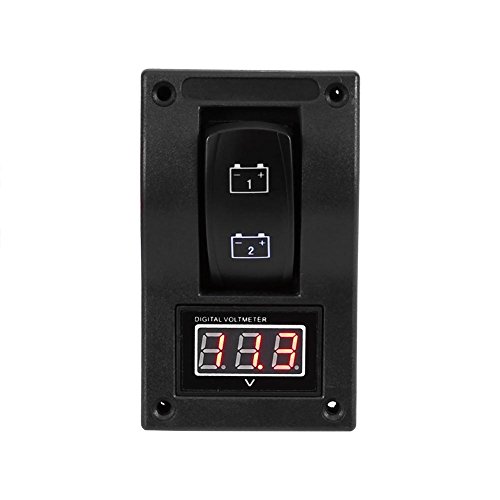
The Acouto panel features a 3-position switch: Battery 1, Off, Battery 2, with an LED indicator on each position. It includes a voltmeter to monitor voltage, helping users verify battery health at a glance. Best for boaters who need quick two-battery testing with clear top/bottom LED signals. It is well-suited for marine or small vehicle setups where space is limited and reliable status is critical. A minor limitation is the potential for LED visibility challenges in direct sunlight, which may affect reading accuracy outdoors.
Qiilu Rocker Switch Dual Battery Panel

Qiilu’s 12V dual battery panel uses a three-position rocker with LED indicators that illuminate in Battery 1 and Battery 2 positions. It’s designed for marine cockpits, trucks, 4x4s, and RVs, delivering a robust plastic panel and rubber-sealed switch. This option is best for buyers seeking a cost-effective solution with straightforward installation and clear two-battery testing signals. It may be less ideal for extremely wet environments unless the rubber seal is properly maintained.
Akozon Marine Dual Battery Panel
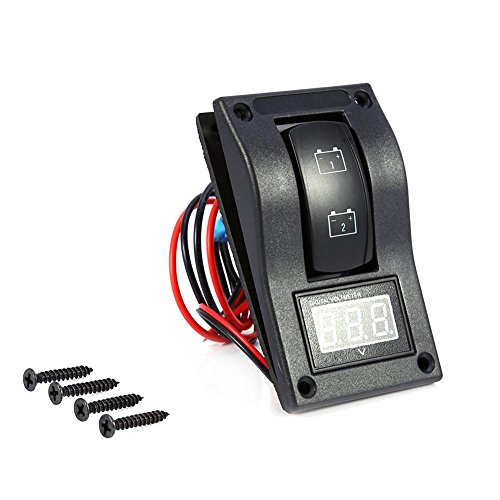
Akozon offers a pre-wired 12V panel with an LED voltmeter to test and monitor battery voltage. It follows the common Battery 1/Off/Battery 2 layout with two green LED indicators. This option is best for users who want a ready-to-wire panel with minimal on-site wiring; it’s suitable for marine cockpits, trucks, and RVs. A potential drawback is that the panel relies on the included wiring harness, so ensure compatibility with your existing setup.
Yosoo 12V Dual Battery Panel

Yosoo’s voltage panel is designed for marine and automotive applications with a three-position switch and green LED indicators for Battery 1 and Battery 2. It suits boat cockpits, trucks, and RVs, offering a straightforward solution for dual-battery monitoring. It’s a solid choice for buyers who want a cost-effective, easy-to-use panel. A possible limitation is that some users may want more robust IP-rated protection if operating in harsh marine environments.
Nilight 90015A Battery Switch Panel

Nilight’s 90015A model emphasizes rugged construction and high current handling for DC 12V systems. It provides an on/off control and a secure isolator function, making it suitable for vehicles, boats, and heavy-duty applications where power disconnection is critical. This choice is best for buyers prioritizing safety and durability in high-stress electrical environments. A caution is to verify需要 continuous current requirements align with your system, as higher draw may necessitate a dedicated high-current switch.
Buying Guide
What should you look for in a battery test switch panel?
- Voltage range and current rating: Ensure compatibility with your system’s voltage (commonly 12V or 24V) and the expected continuous current.
- Indicator clarity: Green LED indicators for Battery 1 and Battery 2 help quick status checks in daylight or night conditions.
- Built-in voltmeter: A voltmeter helps monitor battery health without separate gauges.
- Enclosure and sealing: For marine use, IP-rated or rubber-sealed switches reduce exposure to water and corrosion.
- Wiring ease: Pre-wired panels simplify installation, but verify harness length and connector compatibility with your setup.
- Mounting style: Panel-mounted units require available dashboard space; consider flush vs. surface mounting.
- Durability: Look for rugged housings (ABS or reinforced plastics) for long-term reliability in harsh environments.
How to choose between panels with or without voltmeters?
Panels with built-in voltmeters simplify monitoring and reduce the need for separate meters. If you already own a multimeter or a smartphone-based voltage reader, a panel without a voltmeter may save cost and space. For vehicles or boats where battery health is critical, a voltmeter is highly advantageous.
Best practices for installation
- Place the panel within easy reach of the primary operator, away from direct water exposure in boats.
- Ensure proper fuse protection and secure mounting to avoid vibration-related wear.
- Test the Battery 1/Off/Battery 2 positions before final wiring to confirm LED indicators correspond to the intended battery.
Maintenance considerations
- Inspect seals and connectors regularly to prevent corrosion.
- Check LED clarity and voltmeter accuracy periodically to maintain reliable readings.
- Replace worn components promptly to preserve electrical safety.
What are common limitations to expect?
- Weather exposure: Marine environments demand higher waterproofing than typical automotive uses.
- Wiring harness length: Some panels ship with short leads; plan for extensions if needed.
- Current limitations: High-draw accessories may require a dedicated switch beyond dual-battery panels.
FAQ
- What is a battery test panel? – It is a switch panel that allows you to select between two batteries and monitor voltage, typically with LED indicators.
- Do these panels support 24V systems? – Many models are designed for 12V, some support up to 48V; check the product specs for compatibility.
- Is a voltmeter necessary? – It helps monitor battery health at a glance, but is not strictly required for basic switching.
- Can I install these panels on a boat? – Yes, many models are designed for marine use, but verify IP rating and seal integrity for your waters.
- What is the difference between Battery 1 and Battery 2 indicators? – They show which battery is currently supplying power or being tested.
- Are pre-wired panels easier to install? – Generally yes; they reduce wiring complexity, but confirm harness compatibility with your wiring.)