Answering the common buyer intent, these marine-grade battery terminal blocks organize and secure power connections for boats, RVs, and solar setups. The top picks are best for clean wiring, higher current handling, and corrosion resistance. Choose this if you need durable blocks for 12–48V systems; pick better for heavy-duty marine environments; avoid this if your setup requires compact inserts or unsupported voltages.
| Product | Best For | Key Benefit |
|---|---|---|
| Joinfworld 12V 250A Bus Bar (4 x 3/8″ Studs) | Heavy-duty marine systems | High current, wide cable acceptance |
| RVBOATPAT 12V 150A Marine Bus Bar | Mid-range power distribution | Sturdy design with multiple terminations |
| Joinfworld 12V 250A With 5/16″ Studs | Extended wiring layouts | Strong studs for large connectors |
| IHOTDER 2-Pack 12V Bus Bar (Dual M8 Studs) | Versatile 12–48V use | Double studs, broad compatibility |
| RED WOLF 12V 150A Block (2-Pack) | DIY circuit layouts | Affordable, configurable |
Buying Guide
What to consider when selecting a marine battery terminal block:
- Voltage and current rating: Ensure the block can handle your system’s voltage (12–48V) and continuous current needs.
- Stud size and terminal type: Larger studs (M8/5/16″) accept bigger cables and lugs; verify compatibility with your existing hardware.
- Material and corrosion resistance: Marine environments demand stainless steel, brass, and nylon insulation for durability and safety.
- Mounting and space: Consider nylon bases, mounting holes, and overall footprint to fit your battery tray or box.
- Safety features: Look for flame retardant insulation and secure, non-strippable mounting to prevent shorts.
- Installation convenience: Pre-wired blocks or kits with cable lugs and screw terminals can simplify wiring.
For a practical comparison, the following sections detail five selected products. Each is evaluated for who it’s best for and any limitations based on the listed features.
Joinfworld 12V 250A Bus Bar (4 x 3/8″ Studs)

Best For: Heavy-duty marine electrical systems requiring robust current handling. Why selected: 250A rating in a 12V circuit and 4 x 3/8″ studs allow large connections, plus a thick copper bus bar for lower resistance. Best paired with thicker gauge cables for boat power distribution. Limitation: May be bulkier than compact blocks, requiring sufficient mounting space.
Blue Sea Systems ST Blade Fuse Block Battery Terminal Mount

Best For: Boats needing integrated circuit protection with compact mounting. Why selected: Four fused circuits and included positive/negative blocks create a ready-to-use distribution center. Limitation: Fuses must be chosen and installed separately, and overall ampacity depends on fuse choices.
RVBOATPAT 12V 150A Marine Bus Bar

Best For: Boats and RVs needing reliable 12V distribution with straightforward installation. Why selected: Heavy-duty design with 1 x 1/4″ terminal stud, M4 screws, and included lugs. Limitation: Rated at 150A, which may be low for high-demand systems or future expansions.
Joinfworld 12V 250A With 5/16″ Studs

Best For: Wiring layouts requiring robust connectors and strong mechanical fit. Why selected: 250A rating with 4 x 5/16″ (M8) studs supports larger lugs and wires; nylon base prevents stripping. Limitation: Slightly heavier and may require more space than smaller blocks.
IHOTDER 2-Pack 12V Bus Bar (Dual M8 Studs)

Best For: Versatile 12–48V systems with modular or mixed wiring needs. Why selected: Double M8 studs, stainless construction, and a removable plate for flexible use. Limitation: Maximum continuous current around 80A at 12V, so not ideal for high-demand layouts.
RED WOLF 12V 150A Bus Bar
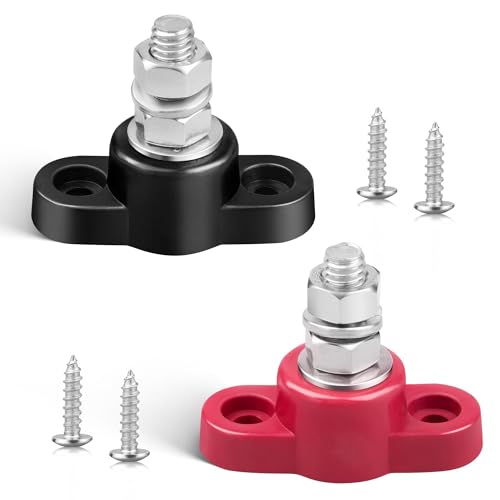
Best For: DIY wiring projects on boats and small power systems. Why selected: 150A capacity with 5/16″ single stud and copper conductor allows robust connections in a compact form. Limitation: Single stud per side may limit distribution complexity; consider multi-block setups for large systems.
FAQ
- What is a marine battery terminal block used for? It distributes power from the battery to multiple devices while keeping wiring organized and protected from shorts.
- What voltage range do these blocks support? Most support 12–48V DC systems commonly used on boats and RVs.
- Should I choose a multi-stud or dual-stud design? Dual or multiple studs accommodate larger cables and higher current, improving reliability in marine environments.
- Are these blocks corrosion-resistant? Marine-grade blocks typically use stainless steel, brass, and flame-retardant nylon for safety and longevity.
- What’s a practical installation tip? Use heatsink-ready lugs and secure nylon bases with proper mounting hardware to prevent movement and wear.