Need a reliable battery selector switch for a small to mid-size boat? This guide highlights five dependable options that help you isolate, combine, or protect battery banks. Each pick is suitable for different setups—two batteries, multiple banks, or tight spaces. Read on to match the best switch to your vessel and usage scenario.
Summary of selected products (quick reference):
- Seachoice Battery Select Switch: Simple two-battery selection for starting, charging, or operation in parallel.
- Blue Sea Systems 4-Position Mini Selector: Compact, versatile, with emergency combine for essential loads.
- RED WOLF 1-2-Both-Off: Heavy-duty, four-position control with high current capacity and ignition protection.
- Blue Sea Systems e-Series 4-Position: Space-saving design with multiple mounting options and ignition protection.
- Nilight 90015A Battery Switch: Heavy-duty 12-48V, high current ratings, robust enclosure for marine use.
Seachoice Battery Select Switch

Best for simpler dual-battery setups where you need straightforward starting and charging options. The Seachoice switch allows selection between batteries for starting, charging, or operation in parallel. It is UL listed, ignition protected, and CE approved, making it suitable for standard saltwater or freshwater boats with two or more batteries under 50V. This option is ideal for skippers who want a dependable, easy-to-install disconnect with minimal maintenance.
Who it’s best for: boat owners with a basic dual-battery system who value compliance and straightforward operation. A potential limitation: it lacks the more advanced multi-battery grouping features found in higher-end models.
Blue Sea Systems 4-Position Mini Selector

The compact 4-position selector is designed for tight spaces while offering essential versatility. It supports emergency combine to draw power from both batteries during engine starting or critical radio use, helping maintain power when one battery is low. Three mounting methods provide flexible installation options. This choice is best for boats needing a space-efficient, emergency-power feature without sacrificing reliability.
Who it’s best for: vessels with limited mounting space that still require a reliable emergency combine function. Caution: installation clearance and wiring must follow mounting method guidance for proper protection.
RED WOLF 1-2-Both-Off Battery Switch

This heavy-duty switch provides robust 12-48V operation with 200A continuous, 300A intermittent, and up to 1000A cranking. It supports 1-2-Both-Off functionality, allowing you to isolate one battery for maintenance or balance loads across multiple batteries. It is ignition protected and suitable for marine, automotive, and RV use. Best for larger or more demanding electrical systems where reliable isolation and high current switching matter.
Who it’s best for: boaters needing strong current handling and flexible battery isolation. Limitation: higher current specs may require careful heat management in hot climates.
Blue Sea Systems e-Series 4-Position
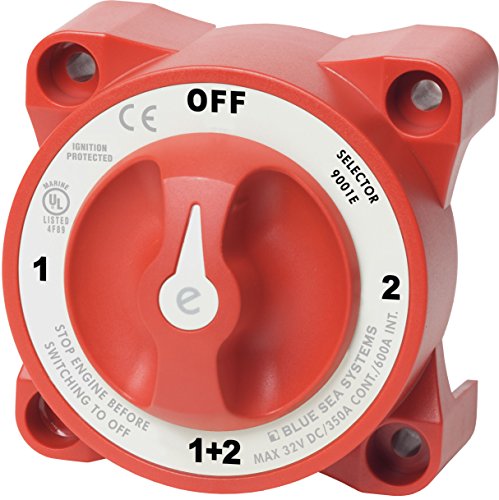
The e-Series 4-Position selector emphasizes compact design and multiple mounting options, including surface or rear mounting. It is ignition protected, allowing placement in engine rooms of gasoline-powered boats. This model suits boats where space is at a premium and engine-room protection is a priority. It provides reliable switching with a small footprint, making it a versatile upgrade for aging or space-constrained panels.
Who it’s best for: boats needing a compact, ignition-protected switch with flexible mounting. Limitation: limited to four positions, which may be less suitable for very large battery banks requiring more complex configurations.
Nilight 90015A Battery Switch

Nilight’s 90015A switch is rated for DC 12-48V, with 275A continuous, 455A intermittent, and up to 1250A momentary. It uses a waterproof, heavy-duty ABS housing designed for marine applications. It supports isolation and power-switching for various configurations, including standalone use or with other switches. This option is best for demanding marine environments where high current handling and weather resistance matter.
Who it’s best for: boats that require strong protection against parasitic drain and reliable disconnect capability. Caution: ensure proper sealing and mounting to maintain waterproof performance in exposed areas.
Malictele 300A 4-Position Battery Switch

This 1-Both-2-Off 4-position selector offers uninterrupted switching with a make-before-break design, preventing power drop during transitions. It uses ABS housing and tinned copper studs for durability and safe disconnection. Best for boats that need reliable, heat-tolerant performance in variable weather. It supports independent battery banks or combined loads with a simple, robust interface.
Who it’s best for: users prioritizing continuous power transfer during transitions and a rugged build. Limitation: ensure compatibility with your cabling and mounting space to fit the 4-position layout.
Attwood 14230-3 Marine Battery Switch

Attwood’s single-pole, four-way selector covers a wide DC voltage range from 6V to 32V. It is rated for 300A continuous at 6V and 150A continuous at 12V, with an automatic alternator field circuit disconnect to prevent surges. This model is well-suited for small to mid-sized boats that need a versatile, simple, and proven battery switching solution. It offers a reliable option for preventing electrical surges from charging systems.
Who it’s best for: compact boats needing a straightforward, proven four-way switch with surge protection. Caution: verify voltage and amperage ratings align with your specific electrical system to avoid overload.
Buying Guide
Key considerations when choosing a boat battery selector switch:
- Voltage and current ratings: Match the switch to your system’s voltage (commonly 12V or 24V) and the highest expected current draw.
- Number of positions: Decide between 2-position, 4-position, or more for the level of control you need (One battery, Both, Off, etc.).
- Make-before-break vs break-before-make: Make-before-break keeps power on during switching; break-before-make can briefly interrupt power but reduces cross-connection risk.
- Mounting options: Consider space constraints and whether surface, rear, or flush mounting best fits your helm or engine room.
- Protection features: Ignition protection, waterproof housing, and corrosion resistance are important for marine environments.
- Emergency or combine features: Some switches offer a dedicated combine function to pull power from both batteries when needed for starting or critical loads.
- Installation and wiring: Ensure terminal compatibility (stud sizes and cable gauges) and that wiring diagrams match your vessel’s electrical layout.
FAQ
- What is a battery selector switch used for on a boat?
It allows isolation or combination of battery banks, helps prevent parasitic drain, and ensures power is available for critical systems when needed.
- What does “make-before-break” mean in switches?
It means the new connection is made before the old one is broken, preventing brief power loss during switching.
- Should I choose a compact or a full-size marine battery switch?
Choose based on available mounting space, required current rating, and whether you need emergency combine or multiple battery banks.
- Is ignition protection important for marine switches?
Yes. Ignition-protected switches reduce the risk of sparks in engine compartments, enhancing safety on boats.
- Can a single switch handle multiple batteries?
Yes, many four-position or multi-bank switches support 1-Both-2-Off configurations to manage two or more batteries.
- Do I need professional installation?
For complex electrical systems or high-current setups, professional installation is recommended to ensure proper sizing and wiring.