Answering the question “which battery cable is best for a boat?” this guide highlights five solid options that are widely used in marine applications. These cables are designed to withstand corrosion, moisture, and outdoor exposure while providing reliable power transfer for boats, RVs, solar setups, and more. Best for different buyers: DIY boat owners upgrading their wiring, installers setting up new battery banks, and anglers or weekend boaters needing dependable, easy-to-handle cables. The table below compares key attributes to help you choose quickly.
| Product | Breadth | Length | Best For | Limitations |
|---|---|---|---|---|
| ABIGAIL 4 AWG 6FT Battery Cable | 4 AWG | 6 ft | Marine, RV, solar or automotive setups needing longer runs | Longer run may increase resistance slightly |
| ABIGAIL 2 AWG Battery Cable | 2 AWG | 1 ft | Short, high-current connections | Short length limits some layouts |
| ABIGAIL 4 AWG 4FT Battery Cable | 4 AWG | 4 ft | Compact installations on small boats | Mid-length; plan routing carefully |
| CARTMAN 4AWG 24-Inch Cables | 4 AWG | 24 in | Engine compartments and tight spaces | Short gauge may require parallel runs for long circuits |
| Linkstyle 6 PCS 4 AWG Cables | 4 AWG | 12 in each | Parallel or modular battery banks | Multiple pieces add connectors to manage |
ABIGAIL 4 AWG 6FT Battery Cable Set

High-quality pure copper wire with tinned copper lugs offers reliable conductivity and corrosion resistance, which is essential for marine environments. The flexible PVC jacket is abrasion-resistant, waterproof, flame-retardant, and heat-insulating. The ends are heat-shrink sealed for extra protection. Best for boat battery banks requiring a longer run between components, or for home solar setups on vessels. Avoid this if you need ultra-short jumpers in tight engine compartments.
Who it’s best for and why selected
- Best for boat owners needing a robust, longer run between the battery and inverter or distribution block.
- Good for RVs and marine applications where exposure to moisture is a concern due to waterproof insulation.
Notes
- One potential limitation is the longer length requirement, which may introduce slight resistance over very long runs.
- Make sure lug size matches your terminal studs (3/8″ is common).
ABIGAIL 2 AWG Battery Cable

This 2 AWG option is designed for high-current short jumps and tight routing. It features the same corrosion-resistant copper and heat-shrink-sealed ends for moisture protection. Best for close-in connections on boats or trailers where a thick gauge is needed but space is limited. Choose this if you need a high current path with a compact footprint; avoid if you require longer distance runs in a single piece.
Who it’s best for and why selected
- Best for short, high-current connections in tight engine bays or compact boat compartments.
Notes
- Length is 1 ft—plan your layout accordingly.
ABIGAIL 4 AWG 4FT Battery Cable
A compact 4-foot length designed for run-ins where space is at a premium. The features emphasize durability, abrasion resistance, and moisture seals, making it suitable for marine battery setups, solar arrays, and vehicles. Best for smaller boats or installations where a shorter, sturdy lead is needed. Better for shorter runs than the 6-foot version if space is very tight.
Who it’s best for and why selected
- Best for small to mid-size boats that need dependable, shorter battery links without excess length.
Notes
- Ensure your terminal size matches the 3/8″ lug diameter.
CARTMAN 4AWG 24-Inch Battery Cables
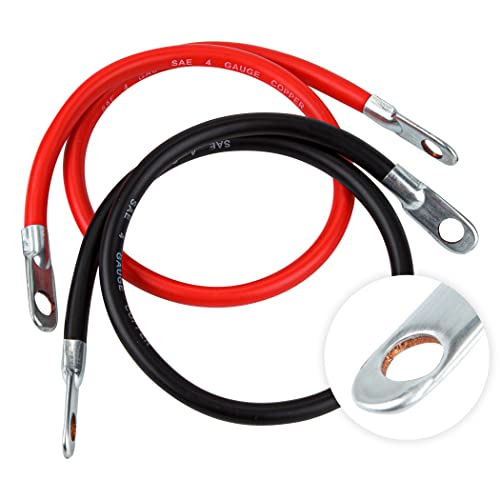
This 24-inch pair targets engine compartments or compact layouts, with 4 AWG copper and 95% copper lugs for good current transfer and corrosion resistance. The shorter length makes routing simpler in tight spaces and reduces resistance over short runs. Best for engine bay connections or where space is limited; choose longer cables if you need to bridge greater distances.
Who it’s best for and why selected
- Best for tight engine compartments on boats or small vehicles where a compact pair is needed.
Notes
- Compatibility with 3/8″ studs is typical; verify lug sizing before installation.
Linkstyle 6 PCS 4 AWG Battery Cables (12 in Each)

This set includes six 12-inch positive and negative copper wires with 3/8″ lugs. Tin-plated copper terminals offer stability and corrosion resistance, while the PVC insulation provides wear resistance and moisture protection. Best for building modular battery banks or parallel/series connections on boats or RVs. Use this if you want multiple short links instead of a single long cable; avoid if you prefer fewer, longer leads.
Who it’s best for and why selected
- Best for modular setups where you plan multiple connections or a daisy-chain layout.
Notes
- Inspect the 3/8″ lug compatibility and plan your layout to minimize extra connectors.
InstallGear 5 Gauge 10ft Battery Cables

This dense, high-quality 5-gauge set is designed for higher current requirements with 99.9% deoxidized copper. The dual-color (red/black) construction helps keep polarity clear, which is important for marine wiring. The kit includes a set of ring terminals that can adapt to various installation needs. Best for larger boat systems, solar-to-battery feeds, or vehicles requiring longer runs with robust current capacity. A longer run is better for power needs, while shorter runs may be more cost-efficient.
Who it’s best for and why selected
- Best for higher-current boat systems where longer copper runs are needed without sacrificing conductivity.
Notes
- Ensure deoxidization level is appropriate for your installation and that connectors fit your lugs.
Buying Guide: What To Consider When Choosing Boat Battery Cables
- Gauge and current needs: Higher current requires thicker gauge. For boats, 4–6 AWG covers most accessory and inverter setups; 2–3 AWG is used for very long runs or high-current banks.
- Length and routing: Measure the distance between the battery, inverter, and distribution points. Shorter runs reduce resistance; longer runs require careful planning for voltage drop.
- Material and finish: Copper is common; copper-clad aluminum is lighter and cost-effective but has higher resistance. Tin-plated lugs improve corrosion resistance and longevity in saltwater environments.
- Insulation and protection: Flexible PVC jackets resist abrasion and moisture; heat shrink seals endpoints to protect against salt spray and rain.
- Terminal compatibility: Verify lug diameter (commonly 3/8″) and stud size to avoid installation issues.
- Versatility: Sets with multiple short lengths offer modularity for complex layouts; single long cables reduce connectors but can be harder to route.
Frequently Asked Questions
- What gauge cable should I use for a typical boat inverter system?
Answer: For most boats, 4–6 AWG is suitable for inverter connections, with 2 AWG for longer runs or higher current if space allows. - Are tin-plated lugs necessary for marine use?
Answer: Tin plating improves corrosion resistance and longevity in salt air and water exposure, which is common on boats. - Can I use copper-clad aluminum cables on a boat?
Answer: Yes, for lighter weight and cost-conscious builds, but expect higher resistance than pure copper and verify current requirements. - Do I need heat shrink on battery cables?
Answer: Heat shrink end sealing helps protect against moisture and salt spray and is recommended in marine environments. - How do I choose between a single long cable and multiple short cables?
Answer: Single long cables reduce junctions but may be harder to route; multiple short cables offer modularity and easier routing in tight spaces.