Answer: If you need robust VHF performance with reliable gain, choose antennas rated around 9 dB for extended range and clearer transmissions. This guide highlights top 5 options that balance gain, durability, and ease of installation. Best for boaters who prioritize reliable long-range communication, frequent offshore use, or environments with interference. The featured picks vary from heavy-duty 9 dB models to strong 6–7 dB alternatives to help you compare effectively. A quick summary table of the chosen products follows to help you compare at a glance.
| Product | Best For | Why Pick |
|---|---|---|
| Shakespeare 6018-R Phase III VHF Antenna | Rugged offshore use | High-quality Phase III design with 9 dB gain for long-range communication |
| Shakespeare 5018 Galaxy VHF Marine Band Antenna | Versatile installs | Brass and copper elements with robust cabling and hardware |
| Retevis MA06 VHF Marine Antenna | Budget-friendly, flexible installs | 3.5 dBi gain, fiberglass, durable for harsh conditions |
| Shakespeare Galaxy 5225-XT | Compact, high-efficiency | 6 dB gain with collinear 5/8 wave elements |
| HYS VHF Marine Antenna | Weatherproof, all-weather boats | 3 dBi gain with waterproof fiberglass design |
Shakespeare 6018-R Phase III VHF Antenna

The Shakespeare 6018-R Phase III VHF Antenna delivers a 9 dB gain with a high-performance element design. It is best for offshore sail and powerboats that require improved signal reach without sacrificing durability. The antenna is built to withstand marine conditions while offering consistent performance across the VHF band. Best for boats that regularly encounter long-range communication needs and varied sea states. A potential limitation is its size, which may require mounting space on smaller vessels.
- Gain: 9 dB
- Material: Durable VHF design with Phase III elements
- Marine-grade construction for harsh environments
- Requires suitable mounting location on deck or hardtop
Shakespeare 5018 Galaxy VHF Marine Band Antenna

The Shakespeare 5018 Galaxy combines brass and copper elements with a stainless steel ferrule and a standard 1/4-14 thread. It includes 20 ft of RG-8/X coax and a PL-259 connector, which simplifies retrofits and long cable runs on larger vessels. Best for boats needing a strong, reliable legacy antenna with ready-to-run cabling. Choose this if you value proven materials and straightforward installation. Limitation: heavier than some compact options, which may require sturdier mounting hardware.
- Materials: Brass and copper elements
- Cable: 20 ft RG-8/X, PL-259 connector
- Thread: 1/4-14 standard ferrule
- Good for: general VHF communication with solid range
Retevis MA06 VHF Marine Antenna

The Retevis MA06 offers a 3.5 dBi gain with a fiberglass body, designed for durable marine use. It comes with 43.3 inches of RG-58 coaxial cable and a PL-259 connector, making it suitable for flexible mounting on various vessels. Best for budget-conscious buyers who still need reliable VHF performance and a weatherproof build. A limitation is the lower gain compared to 9 dB models, which may reduce maximum range in challenging conditions.
- Gain: 3.5 dBi
- Material: Fiberglass, waterproof design
- Cable: 43.3 inches / 1.1 m; PL-259 Connector
- Best for: cost-effective installations on smaller to mid-size boats
Shakespeare Galaxy 5225-XT
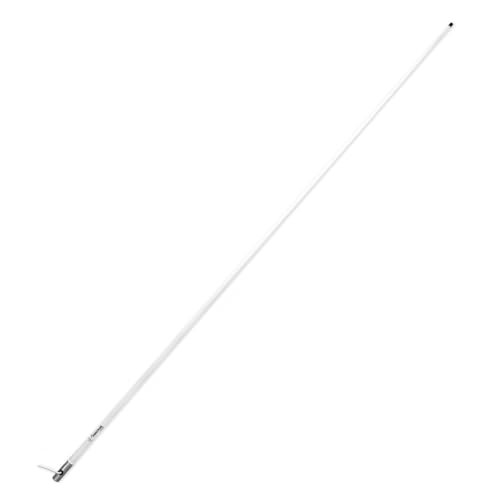
The Galaxy 5225-XT provides a compact yet efficient 6 dB gain, using collinear 5/8 inch wave elements and a white finish that blends with many vessels. Best for boats needing a space-efficient high-performance unit. The one-piece design simplifies mounting on smaller radar arches or limited rails. Better for users who want good range without a long antenna footprint. Limitation: gain is lower than 9 dB options, which may affect long-range reach in poor conditions.
- Gain: 6 dB
- Design: Collinear 5/8″ wave elements
- Finish: White
- Best for: compact installations with solid performance
Shakespeare Galaxy 5225-XT-RL 1-Piece VHF Antenna

The 5225-XT-RL is a one-piece version with a 8′ length and 6 dB gain. It uses a 14-thread stainless ferrule and brass/copper elements to maximize range and efficiency. Best for boaters who want strong range with a simple install and durable hardware. Choose this if you value a longer, single-piece design for clean mounting on rails or a cabin top. Limitation: longer footprint than shorter models, which may constrain some mounting locations.
- Gain: 6 dB
- Ferrule: 14-thread stainless
- Elements: Brass and copper
- Best for: straightforward installation with strong performance
Buying Guide
What matters when choosing a VHF antenna?
Gain, durability, and mounting compatibility are key. Higher gain antennas reach farther but may require sturdier mounts and better mast clearance. Material quality affects durability in saltwater and sun exposure. Consider cable length and connector compatibility to minimize signal loss on longer runs.
How to match antenna gain to your vessel
For coastal racing or close-in boating, 3–6 dB options may suffice. For offshore cruising or crowded marinas with interference, 6–9 dB antennas provide improved range. If space is limited, opt for compact 6 dB designs with efficient element layout.
Mounting considerations and installation tips
- Ensure adequate clearance above the boom or radar for safe folding and minimal interference.
- Use proper coaxial cable length to avoid excessive signal loss; keep runs as short as practical.
- Verify ferrule threading and compatibility with your existing hardware to avoid retrofit issues.
Choosing between hard-coated fiberglass and metal-driven designs
Fiberglass antennas are waterproof and lightweight, reducing corrosion concerns. Metal antennas can offer durability and sometimes marginal gains in certain installations, but may require more careful mounting and grounding.
Best practices for maintenance and longevity
- Inspect connectors and coax for wear and corrosion every season.
- Routinely check the mounting hardware for tightness and integrity.
- Clean the antenna surface to remove salt buildup and prevent galvanic corrosion.
FAQ
- Q: Do I need 9 dB gain for coastal sailing? A: Not always; 6 dB can be sufficient, but 9 dB helps with longer-range transmissions offshore.
- Q: Will taller antennas always perform better? A: Height helps line-of-sight, but gain and installation quality also matter.
- Q: Can I mix brands on the same vessel? A: Yes, as long as connectors and impedance (50 ohms) are compatible.
- Q: Is fiberglass better than metal for marine antennas? A: Fiberglass is typically more weatherproof and corrosion-resistant in marine environments.
- Q: How long should my antenna cable be? A: Use the shortest practical length to minimize signal loss; many setups succeed with 20–43 inches of coax inboard and longer runs to the radio outside).
- Q: Do these antennas require special licenses? A: VHF antennas themselves do not require licenses, but the radios used with them may require proper licensing depending on the jurisdiction and usage.