If you need a reliable three-bank onboard charger, these options deliver independent charging for multiple 12V batteries in marine, boat, starter, and deep-cycle systems. Each product below is chosen for different needs—compact power, rugged waterproof design, and advanced charging modes. This guide helps you pick the right 3-bank charger for your battery types and boating setup.
Summary table of selected products
| Product | Bank Count | Total Amps | Best For | Notes |
|---|---|---|---|---|
| NOCO Genius GEN5X3 | 3 | 15 | Marine vessels needing compact high power | 5 A per bank, temperature compensation |
| Upgraded 3 Bank Marine Charger 10X3 | 3 | 30 | All-around heavy-duty 12V systems | IP68 waterproof, 10 A per bank |
| NOCO Genius GENPRO10X4 | 4 | 40 | Higher power with extra bank | 10 A per bank, compact design |
| Guest 2713A On-Board Charger | 3 | 15 | Basic 3-bank option | 120V input, simple setup |
| NOCO Genius GENPRO10X3 | 3 | 30 | Balanced 3-bank performance | 10 A per bank, robust for harsh marine use |
NOCO Genius GEN5X3: Compact 3-Bank Marine Charger

- Three independent banks, totaling 15 amps (5 amps per bank).
- Meets 12V lead-acid and lithium charging with modes for AGM and Lithium.
- Compact design; temperature compensation helps optimize charging in varying conditions.
Best for anglers and small boats needing a compact, high-performing 3-bank charger. Choose this if you want independent bank control and robust protection in a marine environment. A potential limitation is that per-bank output is 5 A, which may be slower for larger deep-cycle packs.
Upgraded 3 Bank Marine Charger 10X3 (30A)
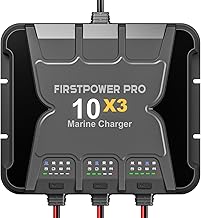
- Three banks with a combined 30A (10A per bank).
- IP68 waterproof, suitable for 24/7 onboard charging and multiple battery chemistries.
- 3 modes: SLA/AGM, Lithium, and Calcium; Force Mode starts charging dead batteries.
Best for marine systems that require higher per-bank output and continuous operation. Choose this if you have several 12V deep-cycle or lithium packs. Note that higher amperage per bank may demand more electrical system capacity and proper mounting.
NOCO Genius GENPRO10X4: 4-Bank Marine Charger

- Four banks totaling 40A; 10A per bank.
- Selectable modes per bank: 12V, AGM, Lithium, and Repair Mode.
- Designed for harsh marine environments with temperature compensation and overcharge protection.
Best for boaters needing higher total capacity and an extra bank for additional batteries. Better for larger vessels or those with multiple 12V packs. Caution: more banks typically require a larger mounting space and power supply considerations.
Guest 2713A On-Board Battery Charger

- 3-bank, 15A total at 12V; 120V input.
- Simple 3-bank configuration suitable for basic multi-battery setups.
- No specific model-specific features listed beyond the basic 3-bank configuration.
Best for buyers seeking an affordable, straightforward 3-bank option. Choose this if you want a basic setup without advanced modes; however, it may lack some of the newer protection and mode options found in premium models.
NOCO Genius GENPRO10X3: 3-Bank 30A Onboard Charger

- Three banks with 30A total (10A per bank).
- Robust design for harsh marine environments and multiple battery types (AGM, Lithium, deep-cycle).
- Each bank supports 12V, AGM, Lithium, and Repair Mode for dead batteries.
Best for balanced performance with a mid-range amperage distribution across three banks. Choose this if you need reliable, independent bank charging with compatibility across common 12V chemistries. Limitation: not as compact as some 3-bank devices with lower total amperage.
Buying Guide: 3-Bank Onboard Charger Considerations
- Battery types and compatibility: Ensure the charger supports lead-acid, AGM, and lithium (LiFePO4) if your boat uses multiple chemistries.
- Per-bank amperage: Higher amps per bank speeds up charging but requires adequate power supply and wiring. Match to your battery size and usage.
- Waterproofing and ruggedness: IP68 or similar ratings are important for exposed marine installation.
- Charging modes and protections: Look for temperature compensation, overcharge protection, and a dedicated repair/boost mode for dead batteries.
- Installation and footprint: Consider space, mounting accessibility, and ease of wiring for three banks.
- Expandability: If future needs grow, consider models with four banks or scalable options.
Frequently Asked Questions
- What is a 3-bank onboard charger best suited for?
Three banks are ideal for boats with three separate 12V batteries or a combination of starter, deep-cycle, and auxiliary batteries.
- What does per-bank amperage mean for charging speed?
Per-bank amperage determines how fast each battery charges. Higher amperage per bank charges faster but requires sufficient power capacity.
- Should I prioritize waterproofing over higher amperage?
Both matter. For exposed marine installs, waterproofing is essential; higher amperage is beneficial if you have large or multiple batteries.
- What charging modes are most useful?
Modes for SLA/ AGM, Lithium, and a repair/boost mode help maintain diverse battery types and recover deeply discharged packs.
- Is a 4-bank charger better than a 3-bank charger?
Not always. It depends on your battery count and space. A 4-bank charger provides more capacity but adds complexity and space needs.