Answering your search for a dependable 3-bank onboard boat battery charger, this guide highlights five top options. Each product is evaluated for boaters who need reliable multi-battery charging, including lead-acid, AGM, and lithium chemistries. Ideal buyers include: weekend sailors needing steady maintenance power, anglers with multiple accessories, and bass boat owners seeking rapid, independent bank charging. Below you’ll find a quick product comparison, followed by detailed sections and a practical buying guide.
| Product | Bank Count | Total Amps | ||
|---|---|---|---|---|
| NOCO Genius GEN5X3 | 3 | 15 | Lead-Acid & Lithium | All-around performance with temperature compensation |
| SOARFLY 3 Bank Marine Charger | 3 | 30 | Lead-Acid & Lithium | High total charging power, flexible modes |
| FirstPower Pro 10X3 | 3 | 30 | Lead-Acid & Lithium | Durable, IP68 waterproof design |
| ProMariner ProSport HD 44021 | 3 | 20 | Lead-Acid & Lithium | Advanced microprocessor charging |
| Minn Kota MK 315D | 3 | 15 | Lead-Acid & AGM | Temperature-compensated, precise charging |
NOCO Genius GEN5X3: 3-Bank, 15A Onboard Battery Charger
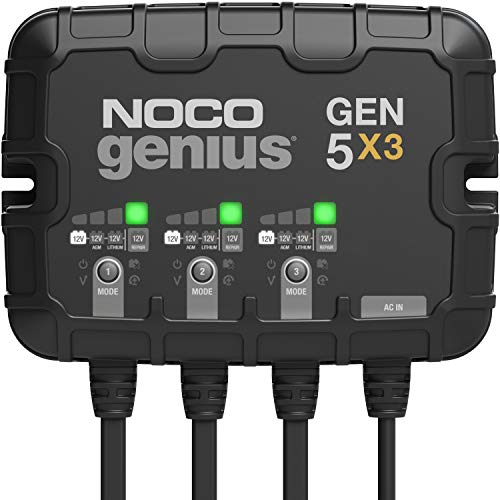
Three independent 12V charging banks deliver 5A per bank, totaling 15A. This unit supports multiple modes per bank: 12V, 12V AGM, 12V Lithium, and a Repair mode. It is designed for marine environments with water resistance and temperature compensation. Best for boaters needing a compact yet capable charger that handles diverse battery chemistries without cross-bank interference.
- Best for mixed battery types across three banks
- Independently programmable banks allow precise maintenance
- Potential limitation: requires careful wiring to ensure optimal heat management in enclosed spaces
SOARFLY 3 Bank Marine Battery Charger

This three-bank charger provides 30A total (10A per bank) with selectable modes for 12V SLA/AGM, 12V Li-ion, and 12V Calcium. Each bank can be controlled independently or charged simultaneously. Force mode is included to revive deeply discharged batteries. Best for boaters who run multiple high-drain systems and want robust, autonomous per-bank control.
- Best for higher total charging capacity across three banks
- Independently controlled banks support flexible configurations
- Caution: operation depends on battery health; deeply discharged packs may still require replacement over time
FirstPower Pro Upgraded 3 Bank 10X3, 30A

Ten amps per bank yield a total of 30A, with IP68 waterproofing suitable for continuous onboard use. Each bank supports 12V SLA/ AGM, 12V Lithium, and 12V Calcium modes. Independent bank operation enables simultaneous charging of multiple battery types while avoiding cross-bank interference. Best for saltwater boats or humid environments where robust sealing matters.
- Best for all-weather, in-water use with durable sealing
- Choose this if you need reliable 30A total with independent banks
- Limitation: heavier unit may require more space in the companionway or battery bay
ProMariner ProSport HD 44021

ProSport HD provides 20A across three banks with microprocessor control for fast, precise charging. It uses distributed-on-demand technology to allocate unused amps as needed. Best for boaters who want responsive, intelligent charging that adapts to how many batteries need power at any moment.
- Best for dynamic amp allocation among batteries
- Benefit: fast charging across all three banks when some batteries are low
- Limitation: may be less intuitive setup for first-time installers compared to some plug-and-play options
Minn Kota MK 315D Digital On-Board Charger

Three-bank charger with 5A per bank, totaling 15A. Features automatic temperature compensation, digital control, and LED indicators for charge stages and faults. Best for anglers and surface-boat users who value precise temperature-adjusted charging and clear status indicators.
- Best for temperature-aware charging in varying climates
- Note: 5A per bank may be limiting for high-energy systems
Buying Guide
Key factors to consider when choosing a 3-bank onboard charger include total output, per-bank amperage, battery compatibility, environmental sealing, and bank independence. For saltwater boats or high-humidity layouts, IP68-rated units are safer choices. If you have diverse battery chemistries, look for selectable modes per bank and a Repair or Force mode to revive marginally discharged batteries. Independent bank operation helps prevent one failing bank from dragging others down.
- Total amp output vs. per-bank amperage: more banks with higher amps can charge faster, but space and heat must be managed
- Battery compatibility: ensure the charger handles lead-acid, AGM, and LiFePO4 or Lithium chemistries as needed
- Protection features: overcharge protection, temperature compensation, and dead-battery recovery modes
- Environmental ruggedness: IP ratings and weather sealing for exposed installations
- Ease of installation: weight, mounting options, and wiring harnesses
FAQ
- Q: What does “per-bank” amperage mean? A: It’s the maximum charging current allotted to each individual bank, allowing independent control of each battery.
- Q: Can I use a 3-bank charger with different battery types at once? A: Yes, provided the charger supports the specific chemistries (lead-acid, AGM, Li-ion, LiFePO4) for each bank.
- Q: Is IP68 worth it for all boats? A: It’s particularly valuable for boats exposed to water spray, rain, or submersion risk.
- Q: What is Force/Repair mode? A: A mode to attempt reviving deeply discharged or damaged batteries by forcing charging under controlled conditions.
- Q: Do I need professional installation? A: If you’re not comfortable with marine electrical wiring, professional installation is advised.
- Q: How do I know if I need 30A total? A: Consider total battery capacity, how many devices draw power, and whether you anticipate simultaneous charging needs.