When you need dependable onboard charging, a 3‑bank boat battery charger is the smart choice for keeping multiple batteries topped up on long voyages or anchored days alike. This guide highlights five top 3‑bank options suitable for lead‑acid, AGM, LiFePO4, and calcium chemistries. Each product is chosen for its balance of performance, versatility, and marine durability, helping boat owners select the charger that best fits their battery setup and cruising style.
The following table provides a quick comparison of the five selected models to help you skim for key features at a glance.
| Product | Output (A per bank) | Battery Types | Waterproof Rating | Best For |
|---|---|---|---|---|
| NoCO Genius GEN5X3 | 5 A per bank (15 A total) | Lead‑acid, Lithium | Waterproof marine design | |
| FirstPower Pro 10X3 | 10 A per bank (30 A total) | Lead‑acid, Lithium | IP68 waterproof | |
| SOARFLY 3 Bank 30A | 10 A per bank (30 A total) | Lead‑acid, Lithium | IP67/IP68 style waterproofing (marine rated) | |
| NoCO GENPRO10X3 | 10 A per bank (30 A total) | Lead‑acid, Lithium | Waterproof marine design | |
| Minn Kota 315D | 5 A per bank (15 A total) | Lead‑acid, LiFePO4 | Automatic temperature compensation |
NOCO Genius GEN5X3: 3-Bank Onboard Battery Charger
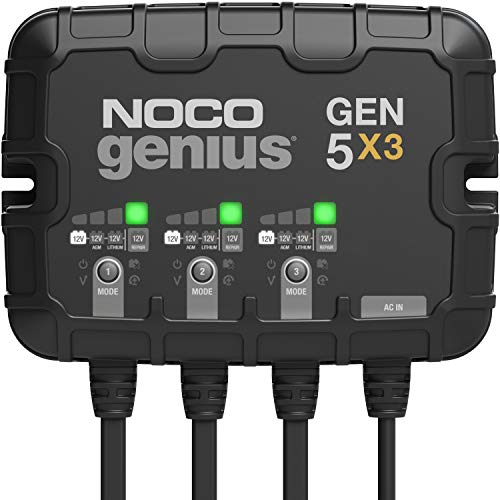
The GEN5X3 delivers 15 amps total, with 5 amps per bank, supporting both lead‑acid and lithium batteries. It features independent bank charging, multiple modes (12V, AGM, Lithium, and Repair), and temperature compensation for marine reliability. Best for boaters who need compact, high‑performing charging across mixed battery chemistries. A potential limitation is its firmware and feature set being best utilized by users comfortable with integrating a three‑bank system on mid‑size boats.
FirstPower Pro 10X3: 3 Bank, 30A Onboard Charger

This charger provides 10 A per bank (30 A total) with IP68 waterproofing, designed for 24/7 use onboard. It supports 12V SLA/AGM, 12V Li‑ion, and 12V calcium, with independent bank control and a Force/Repair mode to revive deeply discharged batteries. It’s best for larger boats or fleets needing robust, continuous charging across multiple battery types. Limitation: higher amperage per bank means more heat and power draw, which may require adequate electrical system capacity.
SOARFLY 3 Bank Marine Battery Charger, 30A

SOARFLY’s unit delivers 10 A per bank and 30 A total, with three intelligent modes for SLA/AGM, Li‑ion, and Calcium. Each bank operates independently, and a Force Mode helps recover dead batteries. Best for boats needing flexible mode selection per battery and strong water resistance. A possible caveat is that some users may prefer a more compact form factor for smaller boats.
NOCO GENPRO10X3: 3-Bank 30A Smart Marine Charger
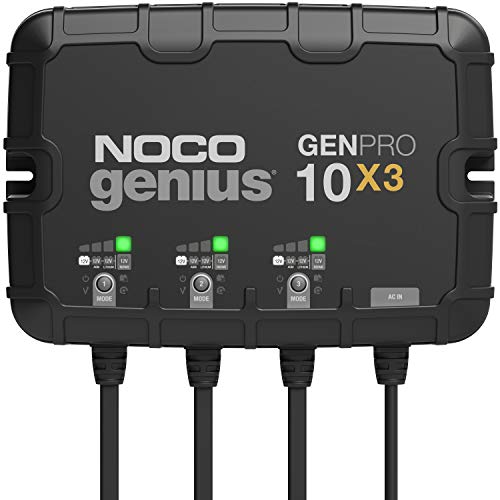
The GENPRO10X3 focuses on compact high‑power charging with 10 A per bank, including 12V AGM and LiFePO4 compatibility and a Repair mode for dead batteries. Best for users needing precise, multi‑chemistry control in a compact package. Limitation: higher total amperage requires a well‑designed electrical system to avoid overloads on small vessels.
Minn Kota 1823155 MK 315D Digital On‑Board Charger

While commonly listed as a 3‑bank, 5 A per bank unit, it emphasizes digital control, automatic temperature compensation, and clear LED indicators. Best for boaters who value easy monitoring and status visibility. Limitation: lower amperage per bank means slower charging when using multiple banks on power‑hungry battery setups.
anegine 3 Bank Marine Battery Charger, 5A/Bank

This 3‑bank unit provisions up to 5 A per bank (total 180 W) and supports lead‑acid and LiFePO4, with Force Mode to revive dead batteries and IP68 waterproofing. Best for smaller boats or users needing a compact, economical, multi‑chemistry solution. Limitation: lower per‑bank amperage may result in slower charges on high‑drain systems.
anegine 30A 3 Bank Marine Charger
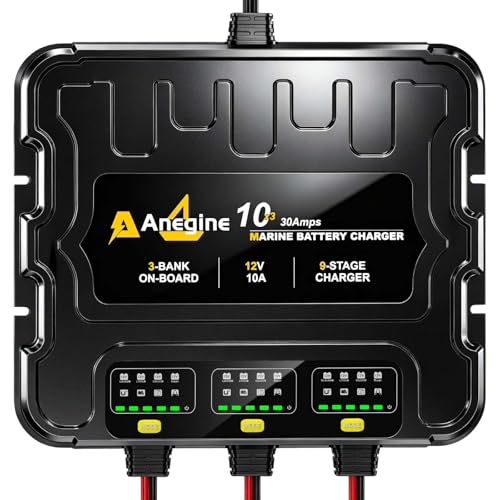
This 3‑bank charger delivers up to 10 A per bank (360 W total) with IP68 waterproofing, Force Mode, and independent bank control. Best for large boats with multiple battery banks, enabling efficient simultaneous charging. Limitation: higher total power requires robust AC input and boat electrical capacity to avoid nuisance trips.
Buying Guide
What to consider when choosing a 3‑bank marine charger:
- Battery types: Ensure compatibility with your battery chemistries (lead‑acid, AGM, LiFePO4, calcium, etc.).
- Amperage per bank: More amperage means faster charging, but it also increases power draw and heat; match to your boat’s electrical system.
- Independence of banks: Independent charging per bank is beneficial for mixed battery sets and maintenance scheduling.
- Waterproofing and durability: Look for IP ratings and marine‑grade construction for exposure to splashes and spray.
- Modes and features: Make note of mode options (SLA/AGM, Lithium, Calcium) and any repair or force modes for recovering dead batteries.
- Size and installation: Consider the physical footprint and whether the unit fits your bilge or dash area without interfering with other gear.
Frequently Asked Questions
- Q: Do I need a dedicated charger for three batteries? A: Not necessarily if you have a true 3‑bank charger with independent channels; it allows simultaneous, balanced charging for each battery.
- Q: Can these chargers charge lithium and lead‑acid at the same time? A: Many models support both, but verify compatibility with your LiFePO4 or other lithium chemistries to ensure proper cycling and safety.
- Q: What is Force Mode? A: Force Mode allows charging of deeply discharged batteries by initiating charging even when voltage is very low, helping revive batteries.
- Q: Is IP68 waterproofing necessary for a marine charger? A: For boats exposed to spray, rain, or submersion risk, IP68 or equivalent waterproofing provides added protection and longer life.
- Q: How do I decide on 5 A vs 10 A per bank? A: If you have small or aging batteries and space constraints, 5 A per bank may suffice; for faster charging on larger banks, 10 A per bank is advantageous.
- Q: Do these chargers require a lot of boat electrical capacity? A: Higher total amperage can demand more AC input and electrical headroom; ensure your shore power and on‑board wiring can support it.
Choosing the right 3‑bank boat battery charger involves evaluating your boat size, battery count, and preferred chemistries. The models above offer a mix of power, protection, and adaptability to help you maintain reliable electronics on water.