Answering the buyer’s search: 2 part boat foam is a two‑part polyurethane foam used for marine flotation, insulation, and void filling. This guide highlights five top options, explaining who each product is best for and why it’s a solid choice for nonstructural marine projects. It’s ideal for boaters, DIY dock builders, and anyone looking to add buoyancy or seal voids without heavy, structural modifications. The selection emphasizes closed‑cell formulas that resist water absorption and solvent damage, plus easy mixing and in‑place curing for quick results.
| Product | Density | Kit Size | Best For |
|---|---|---|---|
| TotalBoat 2 Lb Density Kit | 2 lb/cu ft | 2 gallon | Lightweight flotation and insulation |
| Fiberglass Supply Depot 4 Lb Density Kit | 4 lb/cu ft | 1 gallon | Higher buoyancy and soundproofing |
| Fiberglass Supply Depot 2 Lb Density Kit | 2 lb/cu ft | 1 gallon | Void filling and light deck voids |
| Fiberglass Supply Depot 6 Lb Density Kit | 6 lb/cu ft | 1 gallon | High‑density fills and carving projects |
| TotalBoat 6 Lb Density Kit | 6 lb/cu ft | 2 gallon | Structure‑assisted flotation and casting |
| Oycevila 2 Lb Density Kit | 2 lb/cu ft | 1 gallon | Fence posts, light buoyancy, insulation |
TotalBoat 2 Lb Density Expanding Foam Kit

This 2‑lb density, two‑part closed‑cell polyurethane foam is designed for nonstructural boat buoyancy, insulation, and void filling. It expands rapidly and cures in about 5 minutes at 70–80°F, enabling multiple layers under decks. It’s lightweight and resistant to water, gas, oil, and solvents after curing, and is compatible with coatings like polyester, epoxy, or vinyl ester resins. Best for lightweight flotation projects or interior void filling where a buoyant, watertight fill is needed. Caution: not intended for structural support or heavy weight reinforcement.
Fiberglass Supply Depot 4 Lb Density Foam Kit

This 4‑lb density polyurethane foam provides stronger buoyancy and additional soundproofing. The kit yields about 2 cubic feet per gallon and cures to a form that can be laminated with polyester, epoxy, or vinyl ester resins without melting. It’s well suited for mid‑weight flotation tasks, docking projects, or insulating larger compartments. Choose this if you need higher buoyancy per cubic foot and plan to coat or finish the foam with resin. Limitation: higher density means more weight and potentially slower expansion compared to lighter foams.
Fiberglass Supply Depot 2 Lb Density Foam Kit

This 2‑lb density kit is designed for void filling in nonstructural applications. It expands to fill cavities under decks or inside boats where lightweight buoyancy is needed. Best for smaller projects or where a delicate balance between buoyancy and weight is required. Caution: limited expansion may require multiple pours for larger voids, and handling should follow safety guidelines for urethane foams.
Fiberglass Supply Depot 6 Lb Density Foam Kit

The 6‑lb density foam delivers the highest buoyancy per volume and is suitable for high‑density fills, carving, and sculptural or structural‑like foam projects. It cures to a robust, rigid foam compatible with coatings. Best for applications requiring significant reinforcement or detailed shaping. Caution: heavier and less forgiving for large open voids that require rapid expansion and lighter materials.
TotalBoat 6 Lb Density Foam Kit
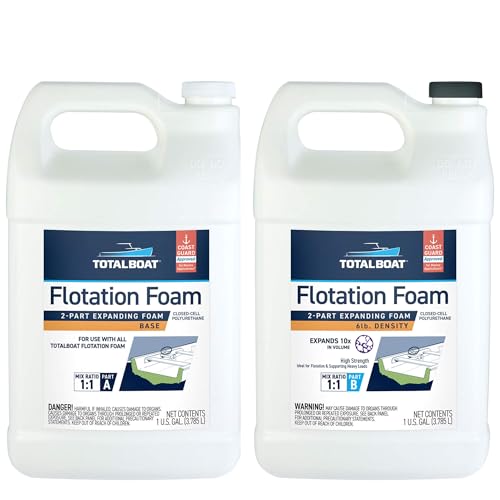
This kit features a 6‑lb density, two‑part marine expanding foam that cures into a hard, rigid foam with high compressive strength. It’s designed for flotation, casting, carving, and reinforcement, offering a 94% closed‑cell structure that resists water and solvents. Best for projects needing durable, sculptable foam or where the foam will contact resin for long‑lasting finishes. Limitation: higher density means more weight and potential slower curing under thick pours.
Oycevila 2 Lb Density Kit (Gallon)

This 2‑lb density kit provides excellent flotation support with a closed‑cell structure that traps air. It’s lightweight yet durable enough to withstand marine conditions, making it suitable for boats, posts, and light marine constructions. Best for fence posts, light buoyancy projects, and insulation. Caution: may require multiple pours for larger cavities to reach the desired buoyancy.
Oycevila 2 Quart Kit Marine Foam

This 2‑quart kit mirrors the 2‑pound density approach in a smaller package. It’s suited for light buoyancy tasks, small voids, and decorative or sealing applications where space is limited. Best for small craft repairs or projects requiring precise, controlled foam fills. Caution: smaller kit size means more frequent refills for larger jobs.
Buying Guide
Key considerations for selecting 2 part boat foam
- Density needs: Lower density foams (2 lb) are lightweight and easy to shape; higher density foams (4–6 lb) offer more buoyancy and rigidity but add weight.
- Open void size: Larger voids benefit from higher expansion foams or multiple pours to ensure complete fill.
- Curing time: Quick cures enable faster turnaround but may require careful batching for layers; slower cures allow more working time.
- Post‑cure finishing: If you plan to coat with resin, confirm compatibility (epoxy, polyester, vinyl ester).
- Water resistance: Look for closed‑cell formulations to minimize water absorption in marine environments.
- Intended use: Nonstructural flotation vs. decorative casting or carving influences the recommended density and curing characteristics.
Practical buying questions
- What density matches my project scope: light deck voids or full flotation cavities?
- Can I coat the foam after curing, and with which resins?
- Will I be pouring in layers or filling one big void?
- Are there safety considerations for mixing and ventilation?
FAQ
- Q: Is this foam suitable for structural reinforcement? A: No, these products are for nonstructural flotation and insulation.
- Q: Do the foams cure hard or flexible? A: Curing varies by density; higher density typically yields a stiffer foam.
- Q: Can I paint or coat cured foam? A: Yes, many are compatible with epoxy, polyester, or vinyl ester resin coatings.
- Q: Will the foam resist seawater and oil? A: Closed‑cell formulations provide resistance to water, solvents, and oils after curing.
- Q: How many pours are needed for large voids? A: Larger voids may require multiple pours to achieve full fill and uniform density.
- Q: Is safety gear required during mixing? A: Yes, use gloves and eye protection and follow the manufacturer’s safety data.