Looking for a reliable 12V solar panel charger to keep your batteries topped off and ready? This guide highlights five top options, each best for different setups like cars, boats, RVs, or trailers. If you need a low-maintenance trickle charger, a high-efficiency MPPT controller, or a rugged outdoor panel, you’ll find clear, buyer-friendly details below. Each product is framed for practical use, with who it’s best for and any notable limitations.
| Product | Best For | |
|---|---|---|
| SUNER POWER Waterproof 12W 12V Solar Battery Charger & Maintainer Pro | Small vehicles, motorcycles, and tight spaces | Ultra-Smart MPPT for higher efficiency |
| SOLPERK Solar Panel Kit 20W 12V | Boats, RVs, and stationary setups | Waterproof build and durable corrosion-resistant frame |
| Voltset 12V Solar Battery Charger – 20W | RV and trailer enthusiasts needing universal 12V support | Advanced protection and smart discharge control |
| POWOXI Upgraded 7.5W Solar Charger | Portable, budget-friendly charging on the go | Smart protection with safe, stable output |
| SOLPERK 30W Solar Battery Charger + 10A MPPT | Trailers, boats, and larger 12V systems | Higher power with robust MPPT and waterproofing |
SUNER POWER 12W MPPT Charger & Maintainer
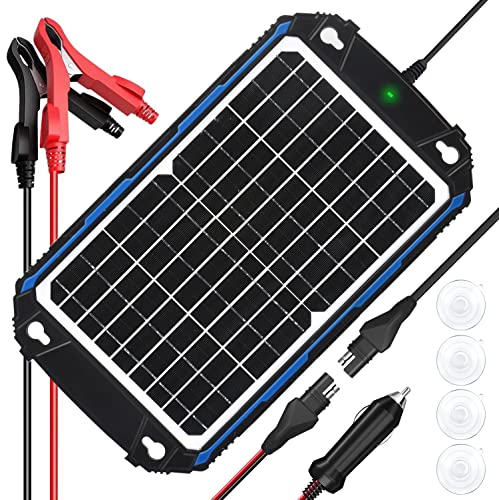
The SUNER POWER 12W charger uses Ultra-Smart MPPT technology to maximize energy harvest from a small panel. It features a 3-stage charging algorithm (Bulk, Absorption, Float) to safeguard and extend battery life. It stops charging at full charge and resumes when the battery drains, reducing maintenance. Best for compact setups such as motorcycles, small cars, or portable power needs where space is limited. A limitation is the lower wattage, which may not suit larger battery banks or high-draw systems.
SOLPERK 20W Solar Panel Kit with MPPT
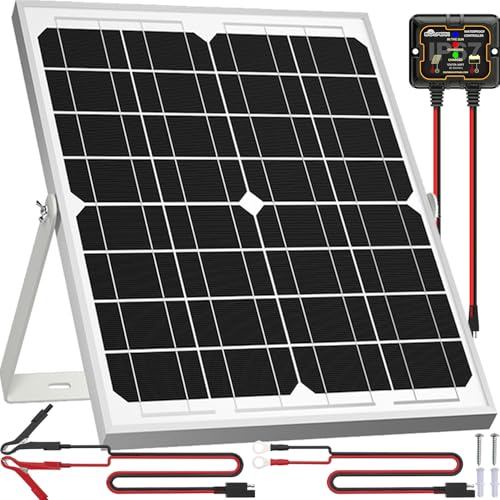
The SOLPERK 20W kit pairs a monocrystalline panel with an MPPT controller and a rugged, waterproof frame. It’s designed to charge and maintain a range of 12V batteries, including LiFePO4 and AGM, for vehicles, boats, and RVs. It withstands harsh weather and offers a strong charging efficiency advantage. Choose this if you need a reliable mid-range system with broad battery compatibility and weather resistance that can stay outdoors long-term. A potential limitation is the mid-range wattage, which may slow charging on very large battery banks.
Voltset 12V Solar Battery Charger 20W

Voltset emphasizes high-efficiency MPPT tracking and universal 12V compatibility, delivering 20-30% faster charging for 12V batteries like LiFePO4 and AGM. It includes multi-layer protection to guard against overcharge, over-discharge, and short circuits, plus a smart controller that prevents parasitic drain at night. Best for RVs, boats, or trailers needing a versatile, smart charger that protects long-term battery health. Limitation: some users may require different mounting options for non-standard spaces.
POWOXI Upgraded 7.5W Solar Charger
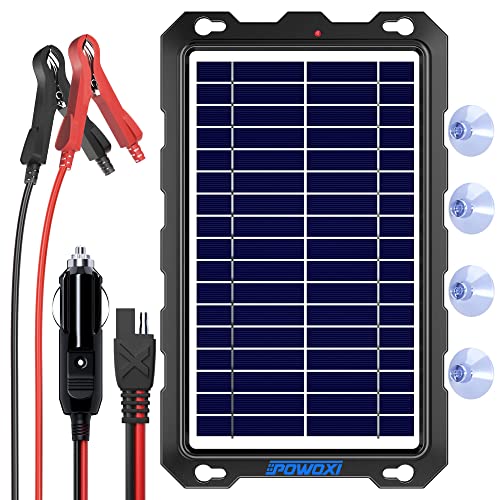
POWOXI offers a compact, portable solar charger with an intelligent charge controller and a protective system that guards against overcharge. It uses high-transparency glass and a robust waterproof build, suitable for cars, boats, and motorcycles. Best for travelers who need a lightweight, plug-and-play option and limited space. Limitations include its lower wattage, which is not ideal for large power demands or frequent full-battery charging.
SOLPERK 30W MPPT Charger with Bracket

This SOLPERK 30W kit integrates a robust 10A MPPT controller, offering over 30% more power than standard controllers. The controller is fully waterproof, protecting the system while charging, and a 360° adjustable bracket enables optimal sun exposure. It’s well-suited for larger 12V systems on trailers, boats, and RVs. A caveat is the heavier setup requiring more mounting effort and space.
Buying Guide
What should I look for in a 12V solar charger?
Key factors include panel wattage, MPPT versus PWM controllers, weather resistance, battery compatibility, and mounting options. Higher wattage delivers faster charging for larger batteries, while MPPT controllers optimize energy harvest in varying light.
MPPT vs PWM: which is better?
MPPT controllers extract more energy, especially in cooler temperatures or partially shaded conditions. PWM is simpler and cheaper, adequate for small, infrequent charging tasks. For most 12V battery setups, MPPT offers better efficiency and longer battery life.
Battery compatibility: which batteries are supported?
Look for universal 12V compatibility that covers LiFePO4, AGM, Gel, Flooded, and Lithium Ion options. This ensures the charger can work with your specific chemistry without risk of overcharging or damage.
Weather and durability considerations
Outdoor installations require waterproof and corrosion-resistant frames, tempered glass, and robust seals. Panels with higher wind and snow load ratings perform better in exposed environments.
Installation and maintenance
Choose systems with easy mounting, flexible connection options (cigarette lighter, alligator clips, OBDII, or ring terminals), and clear indication of charging status to minimize setup time and ongoing maintenance.
FAQ
- Do these chargers work with LiFePO4 batteries? Yes, all listed models advertise compatibility with LiFePO4 and other common 12V chemistries, with protective charging sequences designed to prevent overcharging.
- Is MPPT necessary for 20W panels? MPPT can improve efficiency, especially in challenging light, but a good PWM controller may suffice for simple, infrequent charging tasks.
- Can I mount these outdoors? Most units feature waterproof or weatherproof design, but confirm IP rating and wind/snow load specs for your environment.
- Will these chargers drain my battery at night? Modern controllers include blocking mechanisms that reduce or stop power draw when not charging, preventing battery drain.
- What setup is easiest for beginners? A compact 12V kit with a built-in MPPT, all-in-one mounting hardware, and multiple connection options is typically the most straightforward approach.
- Do these require professional installation? In most cases, no specialized tools are needed; however, ensure proper wiring and secure mounting for safety and optimal performance.