When selecting a battery monitor for boats, you want accuracy, durability, and clear visibility in various lighting conditions. This guide highlights five top options that suit different boat setups—from small day boats to larger RV-marine hybrids. Each pick is evaluated for best use-case, data visibility, and practical limits to help you choose wisely.
Summary table of selected products:
| Product | Best For | Key Benefit | Limitations |
|---|---|---|---|
| SUPNOVA IPX7 Waterproof Battery Monitor | Rugged outdoor boats | IPX7 waterproof rating with 7-100V range | Basic alarm features |
| BINTA Battery Monitor With Shunt | Full-system power monitoring | Real-time SOC, up to 500A peak | Requires shunt install |
| ANCEL BM200-US Car Battery Tester | All-around vehicle and boat use | Cranking & charging tests, Bluetooth | Some vehicle features require permissions |
| ANCEL BM300 Pro | Multi-battery setups | Monitors up to 4 batteries with alerts | 6V SOC limited |
| Renogy 500A Monitor | Lead-acid and lithium compatibility | High accuracy with shunt | Basic interface |
IPX7 Waterproof Battery Monitor With Bracket

The SUPNOVA IPX7 Battery Monitor is designed for harsh environments, including boats exposed to spray or rain. It covers a wide voltage range from 7 to 100V, suitable for 12V, 24V, and higher-system boats. It displays remaining capacity as a percentage and includes a buzzer alarm for alerts. The device is ideal for boat owners who need a compact, durable monitor that withstands outdoor conditions and provides quick at-a-glance status. Best for saltwater or marina use where splashes are common.
Who it’s best for: boaters seeking a rugged, weather-resistant monitor with a simple display and audible alert, for basic capacity awareness and protection against accidental deep discharge. Why selected: IPX7 sealing and wide voltage support make it a straightforward, durable option for outdoor marine environments.
Limitations to note: It offers fundamental capacity percentage display and an alarm but may lack advanced multi-battery or data-logging features found in higher-end models.
BINTA Battery Monitor With Shunt 8-120V

The BINTA monitor provides real-time insights into state of charge, remaining capacity up to 999Ah, voltage, and current. Its shunt-based design supports up to 500A peak and 350A continuous, making it suitable for RVs, boats, golf carts, and larger automotive systems. The crisp backlit display helps visibility in dim or sunlit conditions, and auto-sleep conserves energy. Best for: boaters who want dynamic data across a larger electrical setup with clear, continuous readouts.
Why selected: It combines real-time analytics with wide voltage compatibility and a backlit display, useful for multi-battery boats or systems that run critical electronics. Limitations: It relies on a shunt installation, which adds setup steps and potential wiring considerations.
ANCEL BM200-US Car Battery Tester

The ANCEL BM200-US integrates voltage, cranking, and charging tests with alarm and voltage history. While marketed for 12V automotive batteries, its capabilities translate well to boats with 12V systems, providing quick health checks and real-time monitoring. Best for: boat owners who want a multi-function tester that also supports vehicle maintenance data and trip history. Why selected: Combines testing and monitoring features with alarms for proactive maintenance. Caution: GPS permission may be required for the device to identify vehicle location, which could affect privacy and permissions on mobile devices.
ANCEL BM300 Pro Battery Monitor
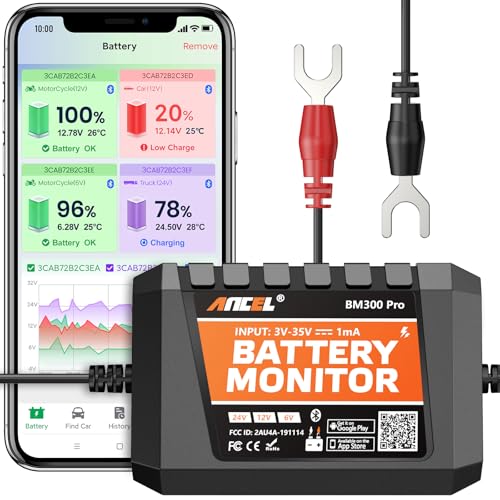
The BM300 Pro is designed for diverse systems, auto-detecting voltages from 6V to 24V and monitoring up to four batteries simultaneously. It uses Bluetooth 5.3 for remote alerts and supports corrosion-resistant, reinforced housing with IP67 sealing. Best for: boaters with complex systems or multiple battery banks who want centralized monitoring and long-term reliability. Why selected: Versatility and robust design for varied marine environments. Limitation: 6V SOC monitoring is limited to voltage and temperature and does not include full charging/cranking tests for all configurations.
Renogy 500A Battery Monitor With Shunt
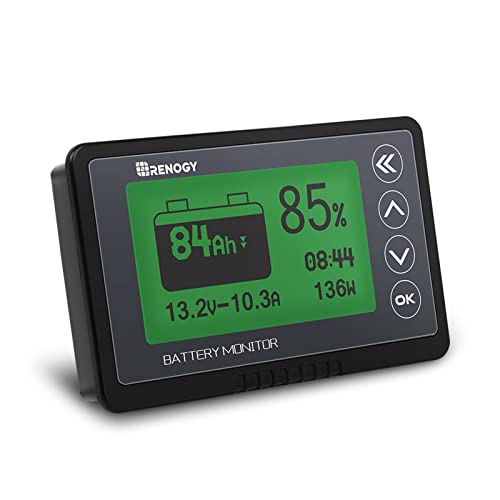
The Renogy monitor uses a shunt to deliver 1% accuracy in real-time voltage and current readings. It supports a variety of battery chemistries, including lead-acid, AGM, Gel, LiFePO4, and lithium-ion, and is compatible with 12V, 24V, and 48V systems. Best for: boaters who want precise monitoring across different battery types without upgrading the sensor hardware. Why selected: High accuracy with broad compatibility. Caution: Some users may want an advanced display or additional data logging beyond standard readouts.
Mislezy 12V Battery Meter

The Mislezy 12V Battery Meter uses a five-segment LED indicator to show 10% to 100% battery power. It includes reverse polarity protection and an auto-sleep feature to conserve energy. Best for: small boats or personal watercraft with straightforward 12V lead-acid systems where visual indicators suffice. Why selected: Simple, energy-conscious design with built-in safety protection. Caution: Only provides basic capacity indication and lacks advanced data metrics in comparison with shunt-based monitors.
Buying Guide
What should you consider when choosing a boat battery monitor?
- Voltage range and system type: Ensure compatibility with your boat’s battery bank (12V, 24V, or larger). If you plan future upgrades, consider a monitor that supports higher voltages or multiple batteries.
- Monitoring type: Shunt-based monitors offer more precise current and capacity data, while simpler voltage-only units provide quick status checks. For critical systems, a shunt-based solution may be preferable.
- Display and visibility: Look for backlit or high-contrast screens for use in sunlight and low-light conditions. Some models include app connectivity for remote monitoring.
- Alarms and alerts: Audible alarms or push notifications help prevent deep discharge and power failures during trips. Ensure alerts are configurable to your needs.
- Durability: Marine environments demand IP ratings and rugged housings. Consider waterproof or dustproof ratings and resistance to vibrations and salt spray.
- Installation considerations: Some units require a dedicated shunt, extra wiring, or Bluetooth modules. Plan wiring routes and space in the electrical panel accordingly.
FAQ
- What is the main difference between a shunt monitor and a simple voltage monitor?
Answer: Shunt monitors measure current alongside voltage to calculate state of charge and remaining capacity, while voltage-only devices provide a basic status indication. - Can these monitors work with lithium batteries?
Answer: Yes, many models support multiple chemistries including LiFePO4 and other lithium variants, in addition to lead-acid options. - Do all monitors require professional installation?
Answer: Some installations are straightforward, but shunt-based systems and multi-battery setups may benefit from professional wiring to ensure accuracy. - Will a Bluetooth-enabled monitor work with my smartphone?
Answer: Bluetooth-enabled models usually pair with smartphones for remote monitoring, but verify app compatibility with your device. - Is IP rating important for marine use?
Answer: Yes. An IP rating (such as IP67 or IPX7) indicates resistance to water and dust, which helps longevity in wet marine environments.
Answer: Check for battery health, connection integrity, and possible deep discharge. Follow the device’s alarm guidance and perform a quick system test if available.