If you’re looking to protect your boat’s electrical system, a reliable battery kill switch is essential. These switches help prevent battery drain during storage, enable quick power shutdown for maintenance, and improve overall safety on the water. This guide highlights five top options, outlining who each product is best for and why it’s chosen. Whether you need a compact side-post design or a rugged top-post unit, you’ll find a clear, buying-focused overview here.
Summary of chosen products:
- Joinfworld Top Post Battery Disconnect Switch (12V-48V): Best for quick, universal negative-terminal installs on boats with post-style batteries.
- Nilight 90015A Battery Switch (12-48V): Best for heavy-duty, waterproof use with strong continuous current ratings.
- PTPUO Top Post Battery Disconnect Switch (12V-48V): Best for durable Nylon 66 construction and easy, flexible installation.
- Gioyonil Battery Disconnect Switch Master (12-48V): Best for universal car/RV/marine use with high current capability.
- Blue Sea Systems m-Series 6006: Best for compact installation in tight spaces with dependable ON/OFF control.
Joinfworld Top Post Battery Disconnect Switch

Best for: Boats that use top-post negative terminals and need a straightforward On/Off control. This unit operates from 12 to 48 volts and is rated up to 250A continuous, with a higher cranking capacity. It includes a negative battery clamp and tapered post for simpler installation. Choose this if you want a simple, reliable switch that’s easy to install on most mid-size boats.
Why selected: The combination of a robust 2-way circuit, clear On/Off action, and included mounting hardware makes this a practical, budget-conscious choice for marine applications. The ABS construction offers durability in marine environments, and the tapered post helps with quick connections during installation.
Limitation: The unit relies on a negative-terminal install, which may require reconfiguring existing wiring in some boats.
Nilight 90015A Battery Switch

Best for: Boats and RVs that require strong waterproof protection and high current capability. This switch supports 12-48V DC systems with 275A continuous at 12V and 1250A momentary capability, making it suitable for larger electrical draws or motorized vessels.
Why selected: Its rugged ABS housing and insulated rear cover protect against short circuits, and it can be used standalone or linked with other switches for multi-point power management. The dual On/Off positions provide clear status while minimizing risk of inadvertent drains.
Limitation: It’s a larger unit, which may require extra space on the panel or deck box in smaller boats.
PTPUO Top Post Battery Disconnect Switch

Best for: Vehicles and boats that need durable Nylon 66 construction with solid brass for conductivity. This top-post switch is rated for 12-48V, with easy 3-way control and flexible installation options.
Why selected: Nylon 66 offers stronger fatigue and flame resistance than typical ABS, enhancing reliability for long-term marine use. The device also emphasizes easy removal-knob functionality for theft deterrence and service safety.
Limitation: The description highlights nylon and brass construction, but actual hardware compatibility should be verified with your battery layout to ensure a clean fit.
Gioyonil Battery Disconnect Switch Master
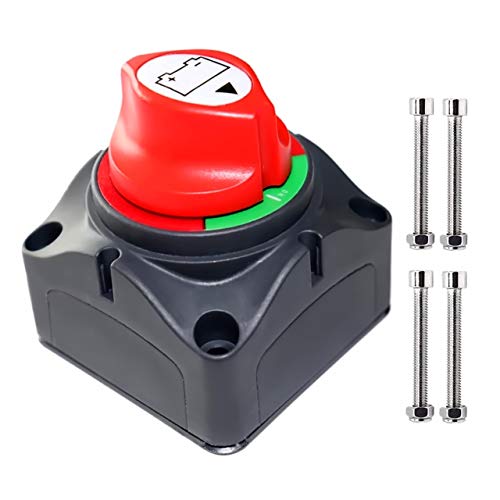
Best for: A broad range of vehicles and boats that require a universal 12-48V disconnect solution with high current capability. This model emphasizes compatibility and secure isolation of the electrical system.
Why selected: The device provides a reliable, high-current isolation option with sturdy construction and broad applicability, ensuring it can handle both automotive and marine setups where a secure cut-off is needed.
Caution: As with any multi-vehicle switch, verify terminal sizing and ensure proper crimping or bolt connections to avoid loose contacts over time.
Joinfworld Side Post Battery Disconnect Switch

Best for: Boats and vehicles with side-post battery configurations that need a compact, high-current cut-off. This unit uses M10 studs and includes copper conductive sheets for efficient connections.
Why selected: The side-post design allows space-saving installation and robust conductors, with 275A continuous and 1250A cranking ratings supporting demanding usage. A rear cover helps prevent accidental shorts during panel work.
Limitation: Side-post configurations may require adapting existing mount points or spacers on some battery trays.
Spurtar Battery Disconnect Switch

Best for: Car, truck, boat, and RV users who need a heavy-duty cut-off with clear On/Off indication. It handles 12-48V systems and features a robust premium build for tough environments.
Why selected: Spurtar emphasizes safety with a strong current rating (200A continuous, 1000A intermittent) and a user-friendly toggle that provides confident feedback. It helps prevent battery drain and supports safer maintenance shutdowns.
Limitation: The unit requires proper wiring practice to maintain a secure seal against moisture in marine settings.
Buying Guide: How To Choose The Right Battery Kill Switch
- Operating voltage and current: Match the switch to your boat’s system voltage (commonly 12V or 24V) and the maximum current draw of essential devices.
- Post type and mounting: Decide between top-post and side-post designs based on your battery terminals and available space. Consider mounting options for panel clearance and water exposure.
- Durability and materials: Nylon 66, ABS, and corrosion-resistant brass components offer different levels of longevity in marine environments. Look for rear terminal insulation to prevent shorts.
- Security features: Some models include removable knobs or tamper-resistant designs for theft deterrence—useful in remote or unattended boats.
- Ease of installation: Consider whether the switch comes with clamps, mounting brackets, or copper sheets. A kit that reduces additional parts can simplify installation.
- Redundancy and scalability: If you use multiple power sources or plan to expand, choose a switch compatible with 2-way or multi-switch configurations.
Practical buyer questions
- What is the most important factor when choosing a battery kill switch for a boat? Focus on compatibility with your battery terminals, voltage, and the required current capacity for your loads.
- Should I choose a top-post or side-post design? Top-post is common for straightforward installs on traditional batteries; side-post can save space in tighter compartments.
- Is a waterproof switch necessary for marine use? Yes, especially for exterior locations or wet environments; look for a sealed housing or rear-terminal insulation.
- Can a kill switch improve battery longevity? Yes, by preventing parasitic drain when the vessel is stored or inactive.
- Do I need a separate switch for each battery bank? For most boats with a single bank, one switch suffices; multi-bank setups may benefit from a miniature selector or dedicated switches per circuit.
Quick reference: Key product differences
- Best for quick install and universal negative-terminal use: Joinfworld Top Post.
- Best for rugged, waterproof, high-current needs: Nilight 90015A.
- Best for durable nylon construction and flexible install: PTPUO Top Post.
- Best for broad automotive/marine compatibility with high current: Gioyonil Master.
- Best for tight spaces and compact panels: Blue Sea Systems m-Series 6006.
Frequently Asked Questions
- What is a battery kill switch and why would I need one on my boat? A battery kill switch disconnects the battery from the electrical system to prevent drain, reduce fire risk, and enable quick power safety during maintenance or storage.
- Can I install a kill switch myself? Yes, in many cases. Ensure you follow wiring diagrams, use proper terminals, and secure insulation to avoid shorts.
- Are there differences between top-post and side-post switches? Yes. Top-post switches fit traditional post terminals, while side-post switches are designed for side-mounted battery terminals and can save space.
- What voltage should I choose? Most boats operate at 12V or 24V. Pick a switch rated for at least your system voltage and sufficient current for your loads.
- Is a removable knob necessary? Not always, but it can deter theft and tampering in exposed areas.
- Do I need multiple switches for more than one battery bank? Some setups require one switch per bank, while others can be managed with a single multi-position switch if designed for it.