Answering the need for reliable, compact water delivery on the water and on the road, this guide compares top marine fresh water pumps. Each choice suits specific setups—great for RVs, boats, yachts, and off‑grid cabins. Use this to decide who should buy which pump, based on flow, pressure, power, and installation needs. The table below highlights five strong options to consider.
| Product | Best For | Key Benefit |
|---|---|---|
| WASSERMANN RV Pump | RV and Marine Onboard Water Systems | 4.0 GPM, 45 PSI with all-in-one kit |
| ECO-WORTHY 33-Series | Off-grid or No-battery Setup | 110V AC, smart pressure switch, adjustable 45–70 PSI |
| SEAFLO 55 Series | High‑demand freshwater systems | 5.5 GPM, 60 PSI, built-in bypass, NSF/UL compliant |
| Gidrox 12V 4.0 GPM | Quiet, compact RV/marine systems | Low 40 dB operation, 10 ft self-prime, 100 ft head |
| MRGVFLO 7GPM 70PSI | High-demand showers and sinks | 7 GPM, 70 PSI, five-chamber diaphragm |
WASSERMANN RV Pump, 12V Self-priming

The WASSERMANN pump delivers up to 4 GPM at 45 PSI. It includes a complete kit with hoses, adapters, a debris filter, and a user manual. Best for RVs or campers needing a straightforward, all‑in‑one package. The 12V DC motor can be powered by a battery or a cigarette-lighter socket in the vehicle. Caution: ensure correct wiring to avoid battery drain or overloading the power source.
ECO-WORTHY 33-Series Diaphragm Pump
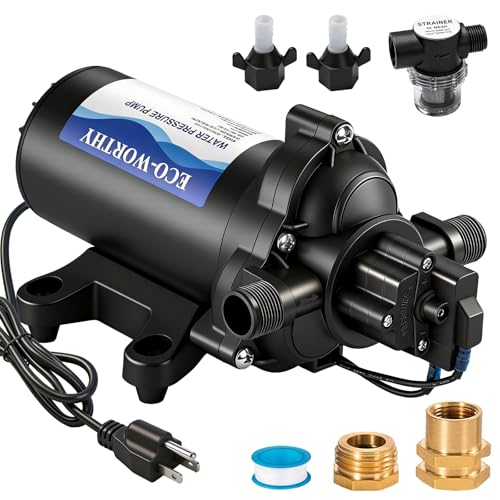
This 110V AC diaphragm pump provides 4.0 GPM with a 50 PSI cut‑in, using a smart pressure switch that turns on and off with demand. It’s suited for installations where an AC-powered pump is acceptable, such as shore power on a boat or RV. It offers self-priming up to 9.8 ft and lift up to 131 ft. Caution: requires a dedicated power source and proper venting; not designed for battery-only operation.
SEAFLO 55 Series 12V RV Pump

The SEAFLO 55 Series offers 5.5 GPM at 60 PSI with a built‑in bypass and a 4‑year warranty. It is built to NSF/UL standards, making it a strong choice for potable water systems on boats and RVs. It supports off‑grid or on‑grid use. Caution: higher flow may demand more power; ensure electrical capacity and fuse rating meet requirements.
Gidrox 12V 4.0 GPM Pump

This 12V pump emphasizes off‑grid reliability with 158°F overheating protection and a noise‑reduction design, producing 4.0 GPM at 45 PSI. It features a self‑priming capability up to 10 ft and a 100 ft head. Best for quiet operation in smaller boats or RVs. Caution: the data suggests robust use, but plan ventilation and mounting to minimize vibration.
[Upgraded] MRGVFLO 7GPM 70PSI Pump
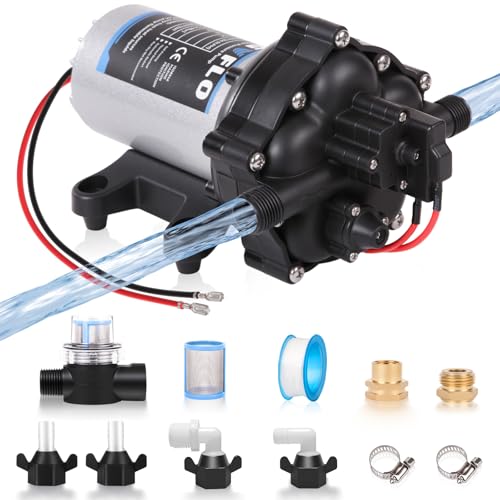
The MRGVFLO pump provides a higher flow of 7 GPM at 70 PSI with a five‑chamber diaphragm design and a heavy‑duty pressure switch. It is well suited for premium onboard systems that require robust water delivery to multiple fixtures. Best for larger RVs, yachts, or campers with multiple outlets. Caution: higher flow and pressure require careful plumbing to prevent leaks and reduce pressure drops across lines.
Buying Guide
How to choose the right pump starts with matching your water system needs to capacity, power, and installation constraints.
- Flow rate (GPM) vs. pressure (PSI): Higher GPM supports more outlets; higher PSI supports stronger faucet jets. For small setups, 4–5 GPM at 45–60 PSI is typical.
- Power source: 12V DC pumps work with vehicle batteries; AC pumps require shore power. Consider the available power supply and wiring.
- Self‑priming capability: Look for pumps that lift water from a lower tank or suction height without manual priming.
- Noise and vibration: Vortex reduction and damping features reduce operator noise, important in compact vessels or cabins.
- Build standards and safety: NSF/UL compliance helps ensure potable water safety. A built‑in safety switch protects the motor from overheating.
- Installation conditions: Check hose fittings, inlet strainers, and mounting compatibility with your space and existing fixtures.
- Maintenance: Consider availability of replacement parts such as diaphragms, valves, and filters for long‑term reliability.
FAQ
- What is the typical best GPM for RVs and marine systems? Most setups use 4–5.5 GPM to reliably supply sinks and showers while maintaining reasonable power use.
- Is a 12V pump sufficient for an entire boat’s water system? Yes, for standard onboard needs, but larger yachts may require higher flow or multiple pumps.
- Do I need a built‑in pressure switch? A pressure switch helps regulate flow, prevent water hammer, and protect the motor. It is common in good marine pumps.
- Can I use an AC pump on a boat or RV? Yes, if you have access to shore power and appropriate wiring. Use a pump designed for potable water.
- What maintenance should I perform? Inspect fittings, replace worn diaphragms, and clean strainers to prevent clogs and loss of prime.
- Which pump is best for quiet operation? Pumps with noise‑reduction features and rubber bases (such as the Gidrox model) are preferable in noise‑sensitive spaces.