Answering the need for reliable high-current charging, these 100 amp marine battery chargers are designed for boats, RVs, and off-grid systems. This guide highlights five top options, clarifying who each is best for, and why. Whether you need multi-bank versatility, lithium support, or robust marine-grade protection, these picks help you compare performance, safety features, and usability at a glance.
| Product | Bank Count | Output (A) | Best For |
|---|---|---|---|
| Victron Energy Centaur 12-Volt 100 Amp 3 Bank | 3 | 100 | Global use, three batteries, excellent safety features |
| LiTime 80-Amp LiFePO4 Charger | 1 | 80 | Fast lithium charging, BMS-protected cells |
| Schumacher DSR Pro INC100 | 1 | 100 | Professional-grade, ECU reprogram compatibility |
| NOCO GEN5X3 3-Bank 15A Per Bank | 3 | 15 total (5A/bank) | Multiple lithium and lead-acid, rugged marine use |
| SOARFLY 3 Bank Marine Charger 30A | 3 | 30 | Flexible 12V SLA/AGM/Lithium modes |
Victron Energy Centaur 12-Volt 100 Amp 3 Bank Battery Charger

The Victron Centaur is a three-bank charger designed for 12-volt systems, providing a robust 100-amp total output. It features auto-ranging input (90-265VAC), enabling global use without swapping adapters, and an internal temperature sense that reduces output under extreme conditions. The charger bulk-charges to 70% of its rate before a four-hour timer shifts operation to float. Best for buyers who need reliable multi-bank charging with strong protection and global compatibility. Caution: heavier size and installation complexity may be a consideration for compact systems.
LiTime 80-Amp Lithium Battery Charger

The LiTime charger delivers up to 80 amps for ultra-fast charging of 12V LiFePO4 packs, making it ideal for RVs, off-grid setups, and solar storage. It supports 0V activation to wake up deeply discharged lithium batteries and employs a three-stage charging process with safeguards against over-temp, over-voltage, and short circuits. Best for lithium systems requiring rapid recharge with protection. Limitations include the need to confirm compatibility with the specific BMS and wiring in your install.
Schumacher DSR Pro INC100
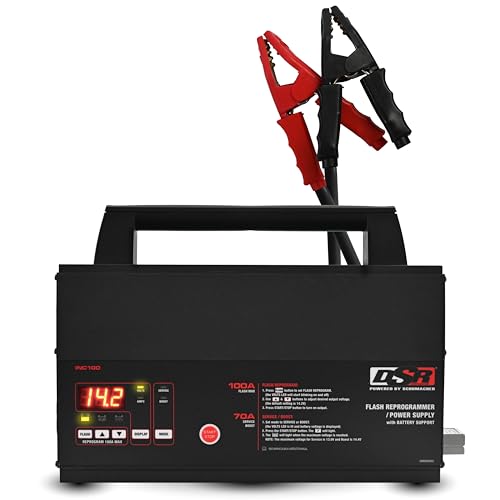
The Schumacher DSR Pro INC100 is a professional-grade charger offering 70–100 amps with up to 13.5V service mode and 14.4V boost mode. It’s designed for demanding marine or automotive use and includes a flash reprogram capability to support ECU reprogramming scenarios. Best for professionals or serious hobbyists who require steady, high-current output during critical maintenance tasks. Limitation: may be larger and heavier than consumer models, and requires secure ventilation to avoid heat buildup.
NOCO GEN5X3: 3-Bank, 15A Per Bank
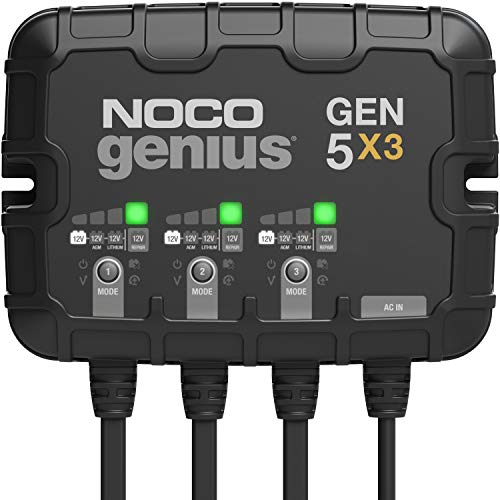
The NOCO GEN5X3 provides three independent banks with a total of 15 amps (5A per bank) and covers 12V lead-acid, AGM, and lithium modes. It offers temperature compensation and overcharge protection in a compact, waterproof marine charger, suitable for boats with multiple battery banks. Best for users needing multi-bank flexibility in a compact footprint. Limitation: total charging current across banks is limited to 15A, which may be slower for high-demand systems compared with higher-output multi-bank units.
SOARFLY 3 Bank Marine Charger 30A

The SOARFLY three-bank charger delivers 30 amps total (10 amps per bank) with modes for SLA/AGM, Li-ion, and Calcium. Each battery can be managed independently, and it supports a “Repair” mode to attempt reviving dead batteries. Best for users who want independent control per bank and flexible mode selection. Limitation: product mentions a repair feature that may require careful interpretation and monitoring during use.
Buying Guide
What should you consider when choosing a 100A marine charger?
- Bank configuration: Do you need 2, 3, or more banks to support multiple batteries simultaneously?
- Battery chemistry: Will you use lead-acid, AGM, or LiFePO4, and does the charger support your battery type?
- Voltage and modes: Are 12V systems sufficient, and do you need lithium activation or a repair mode?
- Environmental conditions: Is corrosion resistance, waterproofing, and temperature compensation important?
- Installation: Do you require a compact unit or one that integrates easily with existing marine electrical systems?
- Safety features: Look for over-temp protection, short-circuit protection, and automatic reduction of output when needed.
Comparative notes: For global use and three-battery setups, Victron Centaur offers robust protection and efficiency. If you need fast lithium charging, LiTime stands out, but ensure BMS compatibility. For professional-grade ECU maintenance or demanding use, Schumacher INC100 provides high-current capability with mode options. If you want compact, multi-bank operation with straightforward mode selection, NOCO_GEN5X3 offers solid performance, while SOARFLY provides flexible multi-bank charging with independent control.
Frequently Asked Questions
- What is the main benefit of a 3-bank charger?
It allows simultaneous charging of three separate battery banks, increasing readiness for critical equipment and reducing waiting time between cycles. - Can I use a 100A charger with LiFePO4 batteries?
Yes, but verify that the unit supports LiFePO4 charging profiles and the battery’s BMS compatibility before connection. - Do these chargers need ventilation?
Yes. High-current chargers generate heat; ensure adequate airflow or enclosure ventilation to prevent overheating. - Is temperature compensation important?
Temperature compensation helps maintain safe charging temperatures and prevents overcharging in hot environments. - What should I check before installation?
Confirm battery type, bank configuration, required voltages, and the charger’s input voltage range for your location. - Are all marine chargers waterproof?
Most are designed for marine environments, but check IP ratings and installation placement to ensure exposure to water is minimized.