Answering the question for pontoon boaters seeking reliable 12V solar charging, these panels and kits are selected for marine use, durability, and simple maintenance. The top picks are best for keeping trolling motors, lights, and onboard electronics charged during day trips and weekend adventures. Ideal buyers include coastal boaters needing maintenance charging, weekend cruisers seeking easy dockside charging, and RV/trailer owners who also boat. The following table highlights the five best options for pontoon boats, with quick notes on suitability and limitations.
| Product | Best For | Key Strength | Limitation to Consider |
|---|---|---|---|
| SUNER POWER Waterproof 12W 12V Solar Battery Charger | Small boats, occasional cruising | Ultra-Smart MPPT and auto recharging | Lower wattage may require longer sun |
| Voltset 20W Solar Battery Charger Kit | Mid-range boats, larger battery banks | Higher wattage, robust protection | Panel size requires mounting space |
| SOLPERK 30W Solar Battery Charger Kit | Active boaters needing flexible mounting | Waterproof MPPT controller | Mounting brackets needed for best angle |
| SOLPERK 100W Solar Battery Charger Kit | Well-equipped pontoon setups | High daily power output | Heavier and larger; mounting planning required |
| Topunive 100W Flexible Solar Panel | Irregular surfaces on boats | Very flexible, lightweight installation | Flexible panel may require careful mounting |
SUNER POWER Waterproof 12W 12V Solar Battery Charger
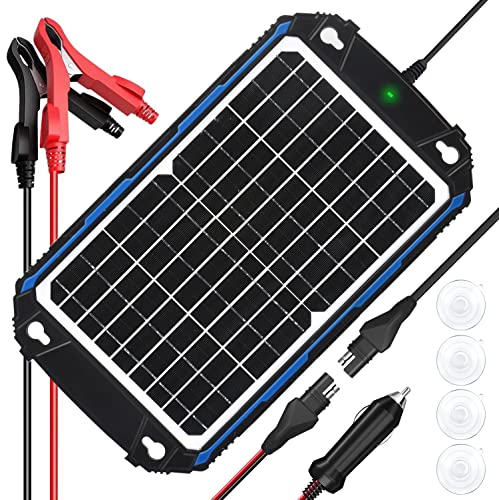
This kit uses Ultra-Smart MPPT technology to maximize power, achieving up to 99% tracking efficiency and up to 98% peak conversion efficiency. It includes an improved three-stage charging algorithm (Bulk, Absorption, Float) to protect and extend battery life. It stops charging at full charge and resumes when needed, creating a maintenance-friendly option for small pontoon setups. Best for smaller boats or boats with limited panel mounting space where low wattage suffices. Caution: Limited output may require sunny conditions to maintain larger batteries.
Voltset 12V Solar Battery Charger – 20W Kit

Voltset offers a higher wattage with a robust MPPT controller, delivering faster charging for 12V batteries. The kit uses A+ monocrystalline panels and includes multi-layer protection, preventing overcharge, over-discharge, short circuits, and reverse polarity. Best for pontoon boats with larger battery banks or boats needing quicker replenishment after use. Avoid this if your mounting space is extremely limited or you need a compact, ultra-light solution.
SUNER POWER 12V 50W Trickle Charger Kit

This 50W kit uses Ultra-Smart MPPT with three-stage charging to maintain boat batteries efficiently. It includes adjustable mounting brackets and is built with durable materials for marine environments. Best for mid-size pontoons needing reliable day-long charging or dockside top-ups. Consider the mounting area and cable length to ensure optimal sun exposure; larger panels require space and sturdy mounting.
SOLPERK 100W Solar Battery Charger Kit

With a high-efficiency MPPT controller, this kit promises significant power gains and waterproof protection suitable for marine use. It targets pontoon setups that require steady daily power, including larger batteries and higher consumption onboard. Best for serious boaters who run multiple devices daily. Limitation: Higher wattage panels are heavier and require careful mounting planning and load considerations.
Voltset Solar Panel Kit 20W with MPPT Controller

This 20W Voltset kit provides efficient monocrystalline solar power with an upgraded MPPT controller. It includes four battery level indicators and supports LiFePO4, GEL, and AGM batteries. Best for pontoon boats with moderate energy use and a need for precise battery health monitoring. Choose this if you want visible charging status indicators and broad battery compatibility. Not ideal for very high daytime energy demand on large systems.
Hhuiyu 20W Solar Powered Battery Charger

This 20W kit emphasizes durability with monocrystalline cells, tempered glass, and a tough ABS frame. It’s suitable for vehicles, boats, and trailers requiring everyday maintenance charging. Best for smaller pontoon setups or backup charging. A caution: limited wattage may not replenish larger batteries quickly in low sun, so plan for longer sun exposure or supplementary charging.
Buying Guide: What to Consider Before Buying Solar Panels For Pontoon Boats
- Power needs: Match wattage to your battery bank and daily energy consumption. Larger boats with more devices benefit from 30–100W kits, while smaller boats may get by with 12–20W.
- Mounting options: Consider space, rail or deck mounting, and the panel’s weight. Flexible panels work well on curved surfaces but may need careful sealing.
- Charge controller type: MPPT controllers maximize efficiency in variable sunlight; PWM is simpler and usually cheaper but less efficient.
- Battery compatibility: Ensure the kit supports LiFePO4, AGM, Gel, and flooded lead-acid if you use mixed battery types.
- Weather resistance: Marine-grade panels and waterproof controllers protect against salt, spray, and humidity.
- Ease of use: Look for auto-resume charging, maintenance mode, and plug-and-play connections to simplify operation.
- Portability vs. permanence: Smaller panels offer portability for weekends; larger kits are better for permanent mounts and higher yields.
FAQ
- What size solar panel is best for a pontoon boat? – For basic maintenance on small batteries, 12–20W can work; for larger battery banks or longer days on the water, 30–100W kits are better.
- Do I need an MPPT controller for marine panels? – MPPT controllers maximize power conversion and are generally beneficial in variable sun, especially on boats with limited mounting area.
- Can I use these panels with LiFePO4 and AGM batteries? – Yes, most kits advertise compatibility with LiFePO4, AGM, Gel, and flooded lead-acid batteries; verify your exact battery type.
- Will a 100W panel fit on a pontoon deck? – It depends on deck layout and mounting. Larger panels require adequate space and sturdy mounting points.
- Are flexible panels suitable for boats? – Flexible panels are good for irregular surfaces but may require careful sealing and mounting to ensure durability.
- Is maintenance charging enough for a pontoon? – Maintenance charging helps maintain battery health and readiness, but consider additional charging sources if you use high-draw equipment frequently.