Answering buyers who need reliable 2-bank battery tenders for boats, yachts, and other marine setups. This guide highlights top 2-bank chargers, focusing on features like independent banks, waterproof designs, and compatibility with lead-acid and lithium batteries. Ideal for boat owners, fleet managers, and campers who require 24/7 maintenance without overcharging. The following picks are chosen for clarity, reliability, and practical, comparison-friendly details.
Quick product snapshot for fast comparison:
- NOCO Genius GEN5X2: 2-Bank, 10A total (5A per bank)
- FirstPower Pro 5X2: 2-Bank, 10A total (5A per bank)
- NOCO GENIUS2X2: 2-Bank, 4A total (2A per bank)
- Battery Tender Plus 2 Bank: 2.5A total (1.25A per bank)
- NOCO GENPRO10X2: 2-Bank, 20A total (10A per bank)
NOCO Genius GEN5X2: 2-Bank Marine Charger

Best for: boat owners needing a compact, high-power solution with precise charge control. The GEN5X2 is 37% smaller and 43% more powerful than its predecessor, offering 10 amps total with 5 amps per bank. It supports 12V lead-acid and lithium batteries, with modes for AGM, Lithium, and a Repair mode for stubborn batteries. Temperature compensation helps prevent overcharge in warm conditions and undercharge in cold scenarios.
Why chosen: Independent bank charging allows simultaneous maintenance of two different battery types. The compact form factor fits tight engine rooms, and the onboard protection features align with harsh marine environments. Caution: Ensure proper venting and location to avoid heat buildup in enclosed compartments.
FirstPower Pro 5X2: 2-Bank 10A Marine Charger

Best for: boaters needing 24/7 charging with robust IP68 waterproof protection. The 5X2 offers two independent banks at 5A each, making it suitable for SLA/AGM, Lithium (LiFePO4), calcium, and deep-cycle batteries. It provides three charging modes and a Force Mode to revive deeply discharged cells. It’s designed for continuous onboard use, minimizing downtime between runs.
Why chosen: The ability to independently set modes per battery is a practical advantage when servicing mixed battery chemistries. Limitation: Some users may prefer higher current per bank for large deep-cycle setups, where a higher-capacity model would be more efficient.
NOCO Genius2X2: 4A Two-Bank Charger

Best for: users who need a compact dual-bank solution with trickle, maintainer, and desulfator functions. The Genius2X2 handles 6V and 12V lead-acid chemistries plus LiFePO4, with a temperature-compensating charge profile to guard against overheating or undercharging.
Why chosen: It provides an all-in-one charging and maintenance workflow with sophisticated chemistry support. Limitation: Lower total amperage per charger means slower replenishment for large or multiple batteries compared to higher-wattage models.
Battery Tender Plus 2 Bank Multibank Charger
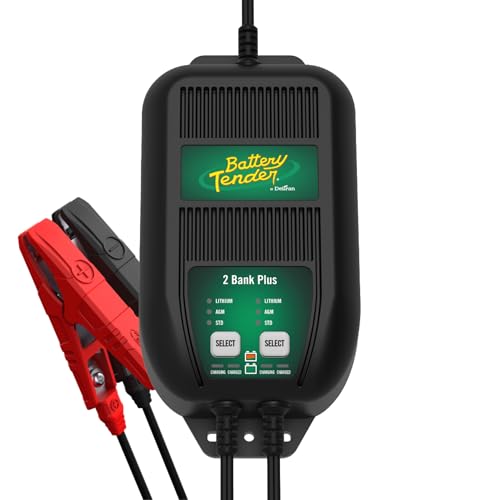
Best for: boaters who prioritize a simple, reliable maintenance charger with a clear status indicator. The Battery Tender Plus provides two independent 12V banks at 1.25A each, with a three-step charging program and temperature compensation for better float performance.
Why chosen: The two-color LED indicators offer quick status checks, and the spark-proof, reverse-polarity protection adds safety. Limitation: Lower charging current per bank means longer replenishment times for larger 12V systems.
NOCO Genius GENPRO10X2: 2-Bank 20A

Best for: users needing higher capacity with two independent banks, suitable for larger marine batteries or fleets. Each bank delivers up to 10A for total 20A, with selectable modes for AGM, Lithium, and standard lead-acid, plus a Repair Mode for stubborn cells.
Why chosen: Higher current per bank translates to faster charging for demanding setups. Caution: The stronger output may require careful heat management in small compartments.
Buying Guide
Key considerations when choosing a 2-bank marine battery tender:
- Charger current per bank: Higher per-bank amperage charges batteries faster but may generate more heat.
- Battery chemistries supported: Look for compatibility with lead-acid, AGM, and LiFePO4 to cover all boats and devices.
- Waterproof and rugged design: Marine environments demand IP-rated housings and robust builds.
- Independent bank operation: Independent charging modes per bank help manage mixed battery systems.
- Temperature compensation: Ensures safe charging across varying conditions on deck or in engine rooms.
- Maintenance and desulfation features: Desulfator and maintenance modes extend battery life and readiness.
How to choose by use case
- Small sailboats with two critical 12V batteries: A 5A per bank solution like GEN5X2 is a strong balance of size and power.
- Workboats with mixed chemistries: A model supporting Lithium, AGM, and calcium with independent banks helps manage diverse packs.
- Fleet operators needing speed: A higher-capacity dual-bank model such as GENPRO10X2 reduces downtime between uses.
- Budget-focused setups: A 4A total two-bank charger can cover basic maintenance for limited battery arrays.
Installation and safety reminders
- Mount in a ventilated area away from direct heat sources and moisture.
- Follow manufacturer wiring diagrams and use appropriate gauge cables.
- Use the Force Mode or dedicated dead-battery recharge features only when needed, per instructions.
FAQ
- What is a 2-bank marine battery tender?
A two-bank charger maintains and charges two separate 12V battery banks independently, often with modes for different chemistries. - Can these chargers work with LiFePO4 batteries?
Yes, most models in this list support LiFePO4 along with lead-acid chemistries. - Are waterproof ratings important?
Yes. Marine environments require waterproof and rugged designs to withstand splashes and humidity. - What does temperature compensation do?
It adjusts charging voltage based on ambient temperature to prevent overcharge or undercharge. - Is a higher amperage per bank always better?
Not always. Higher amperage charges faster but can increase heat. Choose based on battery size and space. - Do these chargers maintain batteries when not in use?
Yes, many include a float or maintenance mode to keep batteries at full charge without overcharging.