Answering the common buyer question: which boat trailer leaf springs perform best in saltwater environments while delivering reliable load support? This guide focuses on corrosion resistance, load capacity, and fit for commonly used trailer axles. The top picks here are suited for salt-influenced marinas and coastal launches, with options tailored to standard 20″, 25″, and 30″ leafs. Best for: recreational boaters needing durable, budget-friendly replacements; professional fleets seeking consistent performance in challenging coastal conditions.
| Product | Leaf Count | Approx. Capacity | Length | Best For |
|---|---|---|---|---|
| Sturdy Built (2) 20″ 3-Leaf Pair | 3 | 3,700 lb per pair | 20″ | Budget-friendly, small to mid-size boats |
| Dorman 26″ 4-Leaf | 4 | 2,000 lb | 26″ | Direct replacement for common trailers |
| Magorfas 25-1/4″ 4-Leaf | 4 | 3,500 lb per pair (1750 lbs per spring) | 25-1/4″ | Balanced strength for mid-range trailers |
| Magorfas 25-1/4″ 4-Leaf, 5,000 lb Axle | 4 | 5,000 lb per axle (2 springs at 2,500 lb) | 25-1/4″ | Heavier-duty saltwater setups |
| Sturdy Built (2) 30″ 3-Leaf Slipper Pair | 3 | 3,000 lb total | 30″ | Longer leafs, larger boats |
Sturdy Built (2) Boat Trailer 3 Leaf Pair — 20″

Features: Heavy Duty Trailer Leaf Spring; 20″ center eye to center eye; 3-leaf design rated at 1,850 lb per spring (3,700 lb per pair).
Best for: Small to mid-size saltwater trailers needing solid, affordable replacement springs. The 20″ length and three-leaf construction strike a balance between ride quality and load support in coastal environments.
Caution: Verify your axle eye-to-eye measurement and load rating before purchase to avoid a mismatched fit. Corrosion resistance depends on coating and maintenance in harsh salt conditions.
Dorman 929-1031 Utility Trailer Leaf Spring

Features: Direct replacement designed to match original fit and function; 1 3/4″ width, 26″ length, 4-leaf, 2,000 lb capacity; durable construction for reliable performance.
Best for: Trailer owners seeking a straightforward, plug-and-play restore for saltwater use where original parts are damaged. A practical choice for widely used trailer models.
Caution: Ensure the spring arch and mounting hardware align with your trailer’s design to maintain proper suspension geometry in salt environments.
Magorfas 25-1/4″ 4-Leaf — 1,750 lb per Spring

Features: 4 leaves; eye-to-eye length 25-1/4″; 1-3/4″ leaf width; 5/16″ leaf thickness; 60Si2Mn manganese steel for strength; two coats of paint for corrosion resistance.
Best for: Trailers that run in salty spray where a robust steel composition improves longevity. Higher corrosion resistance helps in coastal deployments.
Caution: Confirm load rating against your trailer’s axle to avoid under- or over-specifying for your load needs.
Magorfas 25-1/4″ 4-Leaf — 2,500 lb per Spring

Features: 4 leaves; 25-1/4″ length; 1-3/4″ wide; 3/8″ leaf thickness; 60Si2Mn steel with rust-preventive coating; 2,500 lb per spring, 5,000 lb per pair capacity.
Best for: Heavier saltwater trailers that require stronger leaf springs without moving to an oversized axle. Provides reliable support with corrosion-resistance coatings.
Caution: Check compatibility with your existing U-bolts and mounting hardware; increased stiffness can affect ride comfort on rough roads.
Sturdy Built (2) 30″ Slipper Pair — 3,000 lb Total
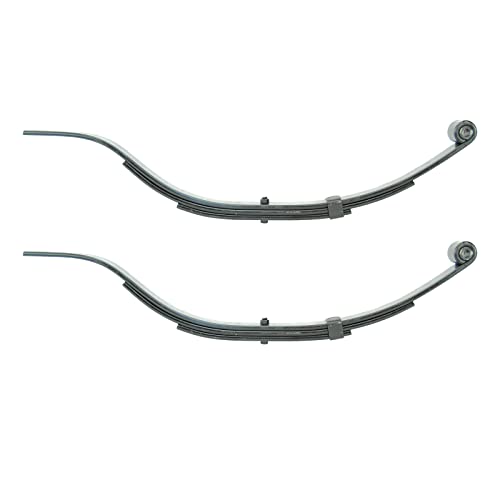
Features: 3-leaf spring rated at 1,500 lb per spring (3,000 lb per pair); 1 3/4″ wide; 30″ center-to-end slipper design.
Best for: Longer leaf springs suit larger or longer trailers, accommodating bigger boats and heavier loads while maintaining stability in saltwater conditions.
Caution: The longer length requires compatible mounting geometry; verify frame clearance to avoid interference with undercarriage components in salt environments.
Buying Guide: Key Considerations For Saltwater Boat Trailers
What matters most when choosing leaf springs for saltwater use? Consider these practical factors to ensure a durable, reliable upgrade:
- Load capacity vs. trailer size: Match the total pair capacity to your boat’s weight and trailer gross capacity. Avoid overloading springs beyond their rating for longevity.
- Leaf count and arch: More leaves generally provide steadier load handling; higher arches suit heavier rides but may affect ride smoothness on rough pavement.
- Material and coating: Stainless or manganese steel with corrosion-resistant coatings fares better in salt spray. Check coating quality and maintenance frequency.
- Eye-to-eye length: Accurate length is essential for proper axle alignment and suspension geometry. Measure before buying.
- Width and thickness: Ensure leaf width and thickness fit your mounting hardware (bushings, U-bolts) and frame design.
- Compatibility with existing hardware: Verify bushing and inner diameter sizes to avoid misfits or the need for adapters.
- Maintenance: Saltwater exposure benefits from regular washing and light lubrication of moving joints to slow corrosion.
- Installation ease: Direct replacements reduce installation time; non-standard lengths may require adaptation or professional help.
Frequently Asked Questions
- Q: Can I mix different brands of leaf springs on the same trailer? A: It’s best to use matching spring specs (length, leaf count, capacity) on both sides to maintain balanced suspension.
- Q: How often should saltwater springs be inspected? A: Check annually for corrosion, cracks, and bushings; inspect after major trips through salt environments.
- Q: Are higher capacity springs always better for saltwater trailers? A: Not necessarily; choose capacity that matches the trailer’s gross weight and boat weight to avoid over-stiffness and wear.
- Q: Do these springs come with mounting hardware? A: Most listing descriptions focus on springs themselves; verify whether bushings and hardware are included or if accessories are sold separately.
- Q: How do I know if a spring fits my axle? A: Compare eye-to-eye length, spring width, leaf count, and arch with your existing axle specs and consult the trailer manufacturer if unsure.
- Q: Should I replace springs in pairs? A: Yes, replacing both sides ensures balanced suspension and even load distribution, which is especially important in corrosive environments.