Answer: For boaters seeking lighter, maintenance-friendly power, a 12V AGM deep cycle battery is typically the best pick. These models balance weight, durability, and reliable reserves for trolling motors, navigation gear, and cabin appliances. The top options below emphasize lightweight construction, sealed AGM chemistry, and solid deep-cycle performance. This guide highlights who each battery is best for, plus practical considerations to help you choose.
Summary of chosen products
| Product | Approximate Weight | Typical Use | Best For |
|---|---|---|---|
| Newport 12V50Ah Deep Cycle Heavy-Duty Marine Battery | 32 lbs | Lightweight, sealed AGM | Trolling motor users needing easy handling |
| Renogy Deep Cycle AGM 12V 100Ah | ~26-27 lb per 50Ah class (approx.) | High capacity, maintenance-free | RV, marine and off-grid with long run times |
| WEIZE Deep Cycle AGM 12V 100Ah | ~27-30 lbs | Maintenance-free, low self-discharge | Marine, RV, solar and trolling motor |
| Interstate Batteries Marine Deep Cycle 12V 70Ah | Varies by model | Dual-purpose, robust performance | Boats needing reliable starting and deep cycle power |
| UPLUS BCI Group 27M 92Ah AGM | ~49-50 lbs | Compact dual-purpose with space-saving design | Smaller boats needing combined starting/deep cycle |
Newport 12V50Ah Deep Cycle Heavy-Duty Marine Battery

Weight: 32 lbs. This lightweight, sealed AGM lead-acid battery is designed for easy transport and installation on a boat. It aims to deliver powerful, reliable performance without adding unnecessary weight. It is trolling motor compatible, supporting longer boating sessions with steady power.
Best for: Boat owners who need a light, maintenance-friendly option specifically for trolling motors or light electrical loads. Limitations: As a lead-acid AGM, it may require periodic inspection of terminals and proper charging to maintain optimal longevity.
Renogy Deep Cycle AGM 12V 100Ah Battery

Brand: Renogy. This AGM battery emphasizes safety, high performance, and versatile connections (series/parallel up to 4P). It’s widely trusted for marine, RV, and off-grid systems, with robust chemistry designed for minimal maintenance.
Best for: Users needing high capacity and proven safety with flexible configuration options. Limitations: Heavier than smaller 50-100Ah packs; ensure your compartment has space for a 100Ah size.
WEIZE Deep Cycle AGM 12V 100Ah Battery

Features include maintenance-free AGM design, low self-discharge, and a long cycle life supported by sealed construction. It is suitable for RVs, solar setups, trolling motors, and marine systems, offering strong discharge performance with a compact footprint.
Best for: Sailors or campers seeking a versatile 100Ah option with low upkeep. Limitations: Proper ventilation and secure mounting are important to prevent leaks in rough seas or during transport.
Interstate Batteries Marine Deep Cycle 12V 70Ah

Brand: Interstate Batteries. This dual-purpose AGM battery provides starting power and deep cycle capacity, designed for rugged marine use. It’s built with thick plates to enable repeated discharging and recharging while aiming for dependable performance on the water.
Best for: Boats needing a versatile battery that starts the engine and runs accessories without swapping modules. Limitations: 70Ah capacity may require more frequent recharges on long days with high power draw.
UPLUS BCI Group 27M 92Ah AGM
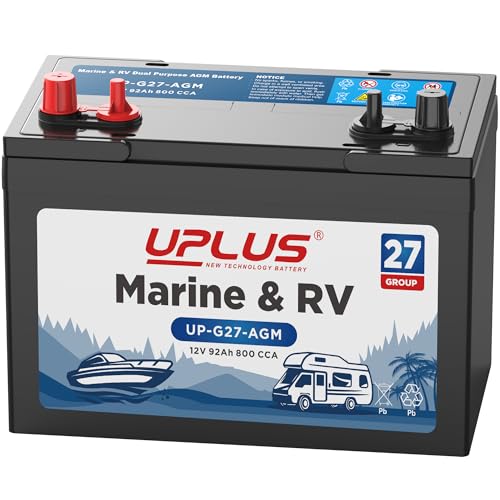
Brand: UPLUS NEW TECHNOLOGY BATTERY. A compact dual-purpose marine battery with 92Ah capacity, 800CCA, and space-saving design. Combines starting and deep-cycle features in one unit, simplifying boat electrical layouts.
Best for: Smaller boats needing a dual-purpose unit to save space. Limitations: Heavier than smaller 50-60Ah models; ensure fit in the battery compartment and weight distribution within the vessel.
Buying Guide
What matters most when choosing a lightweight deep cycle marine battery?
- Voltage and capacity: Most 12V systems with 70-100Ah provide a balance of weight and run-time for trolling motors and electronics.
- Weight vs. capacity: Lighter units reduce boat weight and simplify handling, but verify the capacity meets your daily power needs.
- Chemistry and maintenance: AGM batteries are maintenance-free and leak-proof, suitable for sealed compartments and shore charging.
- Size and fit: Verify dimensions fit your boat’s battery box and space constraints. Some dual-purpose models save space but are heavier.
- Durability: Look for sealed construction and thick plates for better deep-cycle performance and repeated discharge/recharge cycles.
- Charging compatibility: Ensure your charger and alternator support AGM batteries and the expected charging profile (14.4V–14.8V typical).
Practical buying considerations
- Single-purpose trolling motor battery vs. dual-purpose starting/deep-cycle unit: If you rely mainly on a trolling motor, a dedicated deep-cycle model may be best. If you also need engine starting power, a dual-purpose option can simplify wiring.
- Maintenance needs: Maintenance-free AGM options reduce upkeep, but periodic inspection of terminals and connections remains important.
- Space and weight limits: Heavier 100Ah packs may be challenging to fit in compact boats; prefer lighter 50-70Ah models for tight spaces, when run-time suffices.
- Cost and availability: Availability varies by brand and capacity. Consider a reputable brand with a track record for marine use.
Frequently Asked Questions
- Q: Are lightweight deep cycle marine batteries suitable for trolling motors? A: Yes, especially AGM models designed for deep cycling provide steady, long-lasting power for trolling motors.
- Q: What is the advantage of a dual-purpose marine battery? A: It combines starting power and deep-cycle capacity in one unit, saving space and simplifying wiring.
- Q: How long do these batteries typically last on the water? A: Lifespan depends on use, charging practices, and maintenance; AGM batteries often deliver many cycles if kept within recommended temperatures and charging ranges.
- Q: Can I mix different brands in a single system? A: Mixing brands is not recommended due to potential mismatched capacity and charging characteristics.
- Q: What charging considerations are important for AGM marine batteries? A: Use a charger compatible with AGM chemistry and follow the recommended charging voltage and rate for safe, efficient charging.
- Q: How do I know which battery is best for my boat? A: Compare weight, capacity, space, and whether you need starting power in addition to deep cycling for your equipment.