Answered: for boat lifts that run on 24 volts, these panels provide reliable charging and steady power in marine environments. The top picks below are best suited for boat owners seeking durable, weather-resistant panels that can handle intermittent sun, spray, and salt exposure. This guide highlights five options with clear strengths for different needs—including high output, smart charging, and easy mounting—so you can choose the right match for your boat lift system.
| Product | Best For | Key Benefit |
|---|---|---|
| BougeRV 24V N-Type 200W | High-output needs | Bifacial design, higher efficiency |
| SUNER POWER 24V 20W | Small setups, trickle charging | Ultra-Smart MPPT, robust protections |
| Voltset 50W 24V Kit | All-weather maintainer | Full IP-rated durability, fast charging indicators |
| Newpowa 35W 24V | Compact off-grid systems | 10BB cells, solid Vmp/Imp |
| SOLPERK 30W 24V Kit | Versatile RV/boat use | IP67 controller, durable frame |
BougeRV 24V N-Type 200W Panel

This 200W BougeRV panel uses N-Type cells and a bifacial design. It claims a 25% higher conversion rate due to advanced passivation and back contact technology, with an 80% bifacial gain. Best for boat lifts needing substantial daily energy input in a marine environment. It is suitable for RVs, boats, cabins, and other off-grid applications where space allows for a larger array. A limitation is its larger size, which may require more mounting area and sturdier support on a boat lift.
SUNER POWER 24V 20W Solar Charger
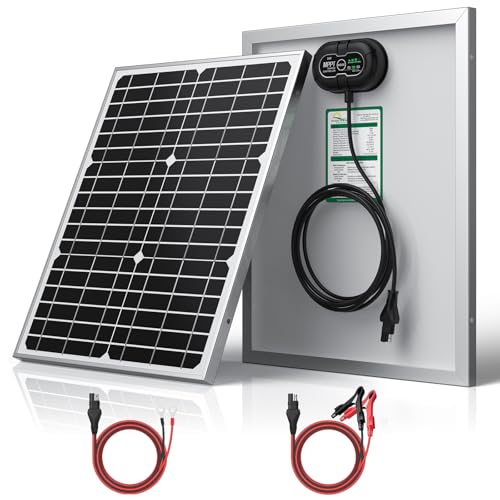
Best for small 24V boat systems or battery trickle charging, this panel features Ultra-Smart MPPT and a three-stage charging algorithm. It includes comprehensive safety protections and is designed for maintenance charging during storage or long periods unattended. Choose this if you have a compact lift setup or as a supplementary charger for a larger system. A potential limitation is its lower wattage, which is not ideal as a sole power source for high-demand lifts.
Voltset 50W 24V Solar Panel Kit

Best for more robust boat lift needs in mixed weather, this 50W kit pairs a high-efficiency monocrystalline panel with an IP67-rated controller and durable frame. It’s designed to withstand wind and snow loads and includes LED indicators to monitor charging status. Choose this if you want a balanced mid-range option with strong waterproofing and a clear, user-friendly controller. A caveat is that 50W may still be insufficient for larger lifts under heavy use without additional panels.
Newpowa 35W 24V Panel

Best for compact installations, this 35W panel uses 10BB cells for improved efficiency and a practical Vmp/Imp for 24V battery maintenance. It’s a solid fit for small boat lifts or as part of a modular system where space is limited. The panel’s smaller footprint is its main advantage; the trade-off is lower total output compared with larger panels.
SOLPERK 30W 24V Kit
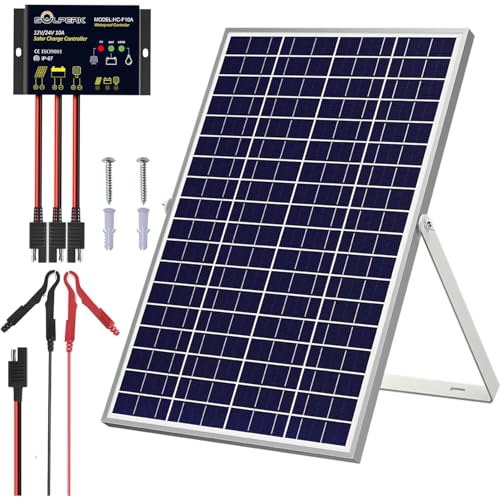
Best for versatile marine and RV use, this 30W SOLPERK kit combines a 30W panel with an intelligent PWM controller and robust mounting options. It emphasizes a durable frame, IP67 waterproofing, and easy installation. It may be more cost-effective than higher-w wattage kits, but like other 30W class panels, it may require multiple units to meet sustained lift needs on larger vessels.
Buying Guide: Choosing The Right 24V Panel For Boat Lifts
- Output vs. space: Larger lifts benefit from higher-wattage panels. If mounting space is tight, consider multiple smaller panels that can be arranged to maximize sun exposure.
- Marine durability: Look for corrosion-resistant frames, tempered glass, and IP-rated controllers. Salt air and spray demand rugged construction.
- Charging technology: MPPT controllers improve efficiency in variable light. PWM controllers are simpler and cheaper but may be less efficient in partial shade.
- Mounting and orientation: Ensure mounting brackets fit your boat lift structure. Adjustable angles help capture sun as the boat moves or tides shift.
- System integration: Check compatibility with your existing battery bank (voltage, chemistry, and max charge rate). Modular kits offer expansion options.
- Maintenance and warranty: Favor panels with corrosion resistance and straightforward maintenance. Warranty terms impact long-term cost of ownership.
Frequently Asked Questions
- What size solar panel is best for a 24V boat lift?
– The ideal size depends on lift power needs and how often you run the lift. For frequent use, higher-wattage panels (e.g., 50W and above) paired with MPPT controllers offer better performance. - Do I need an MPPT controller for a 24V marine system?
– MPPT controllers improve efficiency, especially in variable sunlight and when battery voltage is near depletion. They’re generally recommended for marine 24V setups. - Can a single 24V panel power a boat lift?
– It depends on the lift’s current draw. Small, trickle-charging panels may maintain a battery, but larger lifts typically require higher-wattage panels or multiple panels. - Are bifacial panels worth it for marine use?
– Bifacial designs can increase energy capture, especially in reflective environments. Consider space and mounting orientation to maximize back-side exposure. - What installation considerations are unique to boats?
– Avoid corrosion-prone hardware, seal penetrations properly, and ensure mounting supports withstand wind and wave motion. Regularly inspect wiring for salt exposure. - Can these panels be used with AGM or LiFePO4 batteries?
– Yes, most 24V solar panels are compatible with common 24V battery chemistries when paired with appropriate charge controllers and wiring.