When you need reliable onboard power maintenance, the right battery charger keeps your boat’s systems ready and extends battery life. This guide highlights top onboard 12V boat chargers suitable for lead-acid, AGM, GEL, and lithium batteries. It targets boaters seeking durable, marine-rated performance with temperature compensation and multi-bank options. Best for weekend boaters needing simple maintenance, the top picks also suit anglers, live-aboards, and charter operators who require consistent charge management in harsh conditions. The following table compares the five most relevant products at a glance.
| Product | Bank Count | Max Output | Best For |
|---|---|---|---|
| NOCO Genius GEN5X2 | 2 | 10A total (5A per bank) | Two-battery boats, deep-cycle and starter mixes |
| NOCO GEN5X3 | 3 | 15A total (5A per bank) | Larger 12V systems with three banks |
| NOCO GEN5X1 | 1 | 5A | Single-battery setups or compact boats |
| NOCO GENIUS2D | 1 | 2A | Direct-mount, under-hood maintenance |
| NEXPEAK NC201 | 1 | 10A | Fast, versatile 12V/24V maintenance |
NOCO Genius GEN5X2: 2-Bank, 10A Onboard Charger

The GEN5X2 provides two independently controlled banks with a combined 10A output (5A per bank). It is designed for marine use and offers modes for 12V, AGM, and Lithium batteries, plus a dedicated Repair Mode for stubborn, old, or sulfated cells. The unit emphasizes temperature compensation and overcharge protection to suit unpredictable in-cabin conditions. Best for boats with two battery banks, including a starting battery and a deep-cycle bank, or for small sailboats needing reliable dual-bank maintenance. A potential limitation is its higher cost relative to single-bank chargers for users with only one battery set.
Who it’s best for: boaters with two batteries or separate starter/deep-cycle configurations who want independent bank management. Why selected: compact form factor, multi-mode precision charging, and robust marine-rated design make it a strong all-around choice. Caution: ensure your mounting space supports a two-bank charger and verify that both banks are utilized to justify the investment.
NOCO GEN5X3: 3-Bank, 15A Onboard Charger
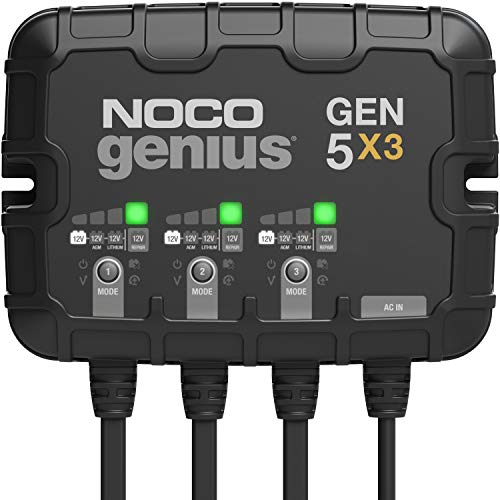
The GEN5X3 delivers three independently controlled banks for 15A total, with 5A per bank. It includes selectable modes for each bank (12V, 12V AGM, 12V Lithium, and 12V Repair Mode) to support mixed battery chemistries on larger boats. This model is best for boats with three distinct battery groups or when you want a higher total charging capacity without sacrificing per-bank control. Limitation: installation requires more mounting space and electrical planning on larger vessels.
Who it’s best for: owners with triple-bank systems or those who want headroom for future battery upgrades. Why selected: scalable multi-bank design and precise mode control by bank enable tailored charging for diverse battery chemistries. Caution: power wiring and fuse sizing must match the higher total current to maintain safety.
NOCO GENIUS1: 1A 6V/12V Smart Charger

The GENIUS1 packs a compact, all-in-one charging solution for 6V and 12V lead-acid and lithium batteries, including maintenance, trickle charging, and a desulfator function. It features an integrated thermal sensor that adjusts charging based on ambient temperature to prevent over- or under-charging. Best for small boats or dual-use vessels needing a simple single-bank charger with smart temperature compensation. Limitation: lower current makes it slower for larger deep-cycle batteries or multi-battery setups.
Who it’s best for: boaters with a single battery or small systems needing automatic maintenance. Why selected: compact and versatile, suitable for tight spaces. Caution: not ideal for high-capacity or fast-charge requirements; plan accordingly for larger boats.
YONHAN Battery Charger 20A 12V/24V

The YONHAN charger offers a 20A capacity with 12V/24V operation and a 7-stage charging cycle, designed to handle 12V and 24V lead-acid batteries across a broad range of chemistries (AGM, GEL, EFB, SLA, Flooded, Calcium). It includes winter mode and smart protections (reverse, overcurrent, fireproof materials, overcharge, short circuit). Best for boats needing faster recharge or those with high-depletion cycles in cold climates. Limitation: not a jump-starter; it requires outlet power to operate.
Who it’s best for: larger boats or owners seeking faster charging with versatile chemistry support. Why selected: high amperage and wide battery compatibility, plus protective features for winter storage. Caution: ensure power availability when docked to avoid outages during heavy charging.
NEXPEAK NC201 10-Amp Charger

The NC201 is a 10A charger with 12V/24V support, designed as a smart maintainer and desulfator for automotive, marine, and deep-cycle batteries. It offers a seven-stage charging cycle and temperature compensation. Best for boats needing a mid-range charger that supports both 12V and 24V systems, including AGM, GEL, SLA, and flooded batteries. Limitation: the adapter should be sized correctly to support continuous use in demanding environments.
Who it’s best for: owners requiring a versatile mid-power charger with repair and maintenance modes. Why selected: balanced amperage and broad chemistry support with temperature-aware charging. Caution: avoid using on totally dead 0V batteries; use repair mode for weak cells only when appropriate.
Buying Guide
How many banks do you need?
Two or three banks are ideal for boats with separate starter and deep-cycle batteries or multiple house banks. A one-bank charger fits smaller boats with a single battery, but you lose independent maintenance for other batteries.
What battery chemistries must be supported?
Look for chargers that support lead-acid, AGM, GEL, and lithium (LiFePO4) chemistries if your boat uses mixed batteries. Multi-mode chargers adapt charging profiles to each chemistry to maximize longevity.
Is temperature compensation important?
Temperature compensation helps prevent overcharging in warm weather and undercharging in the cold. This feature is particularly valuable for vessels in variable climates or dockside storage without climate control.
Should you prioritize speed or precision?
Higher amperage offers faster charging, but precision features—like per-bank modes, desulfation, and repair modes—protect long-term battery health. For mixed or aging batteries, prioritize smart modes over raw current.
Installation considerations
Consider mounting space, ventilation, and wiring. Multi-bank units require adequate space and proper fuse sizing. Direct-mount options may simplify under-hood installation for vehicles or small boats.
Safety and maintenance
Choose chargers with overcharge protection, reverse polarity protection, and short-circuit safeguards. Regular inspection of mounting, connections, and venting supports reliable long-term operation.
FAQ
- Q: Can these chargers work with both 12V and 24V systems? A: Yes, several models support both voltages, enabling use on a wide range of boats and heavy equipment.
- Q: Do these chargers repair dead batteries? A: Some models include a Repair/Desulfation mode, which may recover weak cells; results vary by battery condition.
- Q: Is a multi-bank charger better than a single-bank for a small boat? A: For boats with multiple battery roles, a multi-bank charger ensures proper charging for each bank and reduces cross-talk between batteries.
- Q: Do I need professional installation? A: Installation complexity varies; two-bank and three-bank units may require electrical planning and secure mounting. Follow manufacturer guidelines.
- Q: Will these chargers work in harsh marine environments? A: Marine-rated models with water resistance and thermal management are designed for exposure to humidity and temperature fluctuations.
- Q: Can I use these chargers to maintain batteries during winter storage? A: Yes, most include float charging modes to keep batteries topped up during extended storage.