Answering the need for reliable, on‑board charging, these marine battery chargers support multiple battery chemistries and deliver safe, automatic maintenance at sea or on the water. They’re best suited for boat owners, RV travelers, and off‑grid hobbyists who want dependable charging regardless of engine use or wind conditions. The following picks balance durability, multi‑bank options, and compatibility with SLA, AGM, LiFePO4, and calcium batteries. A quick summary table shows the top five choices and their key strengths.
| Product | Banks / Amps | Best For | Key Benefit |
|---|---|---|---|
| FirstPower Pro 2 Bank 5X2 | 2 banks, 5 A per bank | Small boats needing flexible mode selection | Independent bank modes, dead-battery recovery |
| Zrfmib Smart 2 Bank Charger | 2 banks, 5 A per bank | All‑around boat and RV use | Auto switch between charging and float, independent banks |
| SOARFLY 3 Bank 30A | 3 banks, 10 A per bank | Multiple batteries and higher total power | Three independent banks, force mode for dead batteries |
| ProMariner ProSport HD 20A | 3 banks, up to 20 A total | Rugged, waterproof performance | Microprocessor control and flexible power distribution |
| Anegine 2 Bank 20A | 2 banks, 10 A per bank | IP68 marine environments | Waterproof design with dead-battery recovery |
These selections emphasize marine compatibility, water exposure resistance, and smart charging features that minimize babysitting repairs at sea. For wind‑driven projects, pairing a wind turbine with a capable battery charger helps maintain usable battery power even when wind shifts.
FirstPower Pro 2 Bank 5X2 Battery Charger

Type: 12V battery charger for marine and deep-cycle batteries. Banks: 2; per bank: 5A. Supports SLA/AGM, LiFePO4, calcium, and deep-cycle batteries. IP68 waterproof and fully sealed for onboard use. Each bank can select a mode independently via the MODE button. It also includes a Force Mode to revive dead batteries when voltage is below 1V.
Best for: Small to midsize boats needing reliable 2‑bank charging with independent modes. Better for owners who value 24/7 onboard maintenance and dead‑battery recovery without manual intervention.
Limitation: For higher total charging needs, consider a higher‑amperage option if you operate multiple high‑draw devices simultaneously.
Zrfmib Smart 2 Bank Marine Charger

Type: 12V battery charger with two banks, 5A per bank. Automatically switches between charging and float, supports SLA/AGM, LiFePO4, and calcium batteries. Each bank operates independently; can revive deeply discharged batteries by using Force Mode at low voltage. IP54/IP68‑like protection for marine environments is highlighted by the design.
Best for: Boat owners who want a compact, reliable 2‑bank solution with independent control. Choose this if you need straightforward maintenance charging on two separate batteries.
Caution: Ensure wiring complies with boat electrical standards for safe operation in rough seas.
SOARFLY 3 Bank 30A Charger

Type: Three‑bank charger with 10A per bank. Supports 12V SLA/AGM, Li‑ion, and calcium batteries. Each bank charges independently, with an automatic ability to handle dead batteries via Force Mode. IP68 waterproof design supports marine use and wet environments.
Best for: Boats with multiple batteries or systems requiring independent charging in three banks. Better for users seeking higher total charging capacity in a single unit.
Limitation: Higher amperage means more space and mounting considerations on compact vessels.
ProMariner ProSport HD 20A

Type: Three‑bank charger with distributed‑on‑demand technology for flexible power distribution. Each bank operates intelligently to maximize charging efficiency. Waterproof and designed for harsh marine environments.
Best for: Users who want a rugged, software‑driven charger that adapts to battery needs across three banks. Choose this for more precise, fast charging on larger boats or fleets of batteries.
Limitation: May be overkill for simple two‑battery setups or smaller craft with modest charging needs.
Anegine 2 Bank 20A
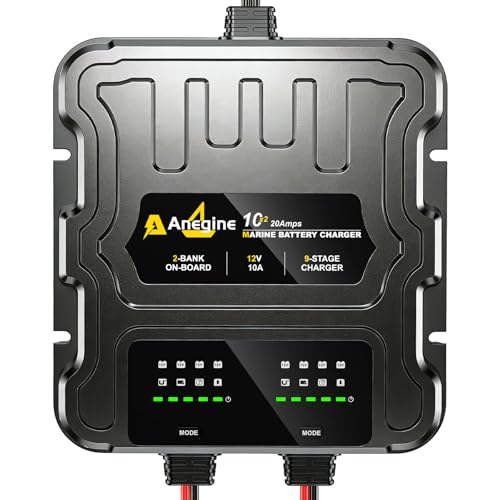
Type: Two‑bank charger with 10 A per bank. IP68 waterproof rating, independent bank operation, and dead‑battery recovery via Force Mode. Suitable for many 12V battery types including SLA, AGM, LiFePO4, and calcium.
Best for: Boats needing a compact two‑bank solution with solid waterproofing for sea spray and splashes. Choose this if you want dependable performance in tight engine rooms.
Limitation: Not as feature‑rich as higher‑end models; consider if you require more than two banks in one unit.
Buying Guide
What battery chemistries must the charger support?
Look for chargers that support SLA/AGM, LiFePO4, and calcium 12V batteries. This ensures compatibility across common marine batteries and future upgrades in your vessel’s power system.
How many banks do you need?
Consider boats with multiple batteries or separate systems. A 2‑bank unit is often enough for smaller boats, while 3‑bank or higher provides more flexible charging for larger vessels or fleets of batteries.
Is IP rating important?
Yes. Onboard, a charger should withstand water exposure. Look for IP68 or equivalent waterproofing to ensure operation in wet environments and during heavy seas.
What about dead-battery recovery?
Many models include a Force Mode to revive deeply discharged batteries. This can be essential for boats that sit unused for periods or face low charge states from long trips.
How does independent bank charging help?
Independent banks prevent one battery’s state of charge from impacting others. This is beneficial for optimizing each battery’s lifespan and performance, especially when different devices draw uneven power.
Is a display or monitoring feature useful?
LCD or LED indicators help verify charging status and bank health. If you manage maintenance remotely or want quick checks, prefer models with clear status indicators.
Installation considerations
Check mounting space, wire gauge, and vehicle/boat electrical code requirements. Ensure the charger’s voltage and amperage fit your wiring, fuse boxes, and alternator capabilities.
Wind turbine pairing considerations
When pairing with a marine wind turbine, use a charger that can accept varying input and protect against overcharging. An intelligent charger with float mode helps stabilize battery voltage and extend cycle life even as wind patterns change.
FAQ
- What is the benefit of multiple banks on a marine charger? Multiple banks allow independent charging for each battery, preventing cross‑talk and ensuring optimal charging for each battery type and state of charge.
- Can these chargers work with LiFePO4 batteries? Yes, several models explicitly support LiFePO4, along with SLA/AGM and calcium chemistries.
- What does Force Mode do? Force Mode initiates charging for deeply discharged or dead batteries, potentially reviving batteries that sit at very low voltages.
- How important is waterproofing? Very important for marine use. An IP68 rating indicates protection against prolonged submersion and water exposure.
- Should I choose a 2‑bank or 3‑bank charger? Choose based on the number of batteries and your power needs. A 3‑bank unit supports more devices or separate circuits on larger boats.