Yes—solar-powered outboard motors are trending, but in practice many buyers rely on electric trolling motors and solar-ready battery setups to extend their boating time. This guide highlights five Newport Vessels models that pair well with solar charging plans, explaining which boaters benefit most, how each model stacks up, and practical considerations for solar integration. Whether you fish, kayak, or coastal paddle, use these options to boost efficiency, reduce noise, and extend time on the water with renewable energy support.
Overview of top options for solar-minded buyers:
| Product | Best For | Why Selected |
|---|---|---|
| Newport NV-Series 36lb | Light kayaks and small craft | Low weight, saltwater-capable, efficient 2-blade propeller for longer run times |
| Newport NV-Series 55lb | Small boats needing more push | Balanced power with corrosion-resistant build and adjustable features |
| Newport Kayak Series 55lb (24″ Shaft) | Kayaks needing deeper shaft | 24″ shaft for variable depth, reliable saltwater hardware |
| Newport NT300 Electric Outboard | Extended trips with high efficiency | 3HP equivalent, long range, digital throttle, quiet operation |
| Newport NV-Series 46lb | Balanced power for inflatables and small boats | 3-blade propeller, saltwater-rated, higher thrust than 36lb |
Buyer type guidance: anglers and recreational paddlers who want longer days on water with solar charging support; saltwater users needing corrosion resistance; those who value adjustable shafts and easy handling for compact craft. Each entry provides a clear “best for” note and a practical caution to help plan your solar-powered setup.
Newport NV-Series 36lb Thrust Trolling Motor

Best for light vessels such as kayaks, canoes, and small boats where portability matters. This 36lb thrust motor supports 12V or 24V setups and features a saltwater-ready design with a corrosion-resistant build. The two-blade propeller is optimized for battery life, delivering steady propulsion with minimal drag. Best for anglers or minimalists who need quiet operation and easy handling on smaller craft. Caution: lower thrust may be insufficient in windy conditions or stronger currents.
Newport NV-Series 55lb Thrust Saltwater Motor
Better for boats needing more push while maintaining reliability. This 55lb motor runs with 12V, offering eight speeds, a 30-inch shaft, LED battery indicator, and a 3-blade prop for improved low-end torque. It’s suitable for longer trips and rougher conditions where solar charging plans require efficient energy use. Best for small tackle boats or inflatables that need extra thrust. Limitation: larger size and weight may reduce portability compared to smaller models.
Newport Kayak Series 55lb Thrust (24″ Shaft)
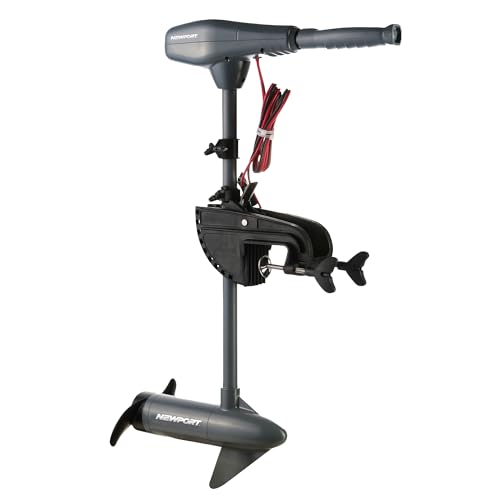
Best for kayaks requiring a deeper shaft for variable depth placement. This saltwater-rated motor features an aluminum head and corrosion-resistant hardware, with an 8-speed option (5 forward/3 reverse) and a 6-inch telescoping handle. A solid choice for solar setups that need stable, all-day operation with reduced motor noise. Caution: 24-inch shaft may require fitting checks on very shallow water to prevent drag.
Newport NT300 Electric Outboard

Best for extended trips with high efficiency. The NT300 delivers 110lb of thrust on a 36V system, offering up to 66 miles of range on a single charge and up to 30 hours of runtime depending on conditions. It includes a digital LCD throttle, 24.6-inch shaft, and a 9.8-inch propeller. This model is ideal for longer fishing excursions or recreational boating where solar charging can replenish power between segments. Caution: higher voltage setup requires compatible battery and charger planning.
Newport NV-Series 46lb Thrust
Best for inflatables and small fishing boats needing stronger push. The 46lb thrust model increases power while maintaining saltwater durability with a 3-blade propeller for smoother operation in wind or light current. It features a 30-inch shaft and LED battery indicator for at-a-glance power monitoring. Consider this choice if you need a bit more thrust without moving to the larger 55lb class. Caution: higher thrust may require larger battery capacity to maximize solar charging cycles.
Buying Guide
What to consider when pairing an electric trolling motor with solar charging:
- Boat type and size: Choose thrust and shaft length based on vessel weight, water conditions, and mounting space.
- Battery system: Solar-ready setups work best with 12V or 24V batteries and an efficient charge controller. Ensure compatibility with the motor’s voltage.
- Propeller type: A 3-blade propeller often provides smoother thrust in windy or choppy water, while a two-blade prop saves weight and can extend runtime on smaller craft.
- Efficiency vs. power: Higher thrust offers better control but increases energy demand. For solar, balance needed thrust with battery capacity and sun exposure.
- Durability: Saltwater-rated hardware and corrosion-resistant components extend life in marine environments and improve long-term solar reliability.
- Mount flexibility: Consider whether the shaft length and tilt/tiller adjustability fit your typical water depth and fishing style.
Practical solar integration tips
- Pair a high-capacity, deep-cycle battery bank with a solar charger designed for marine use to maximize daily runtime.
- Use a battery monitor to track state-of-charge and plan recharging windows around sunny hours.
- Store and route solar cables safely to avoid snagging on gear or hull fittings.
FAQ
- Can I use a solar panel directly with a trolling motor? No. A solar panel charges a battery, and the motor draws power from the battery via an appropriate controller and wiring.
- What shaft length should I choose? Paddle depth and typical water level determine shaft length; deeper water generally benefits from longer shafts (24″–40″).
- Is higher thrust always better for solar use? Not always. Higher thrust increases energy use, so balance with battery capacity and sun hours.
- Are these motors suitable for saltwater? Yes. All listed Newport Vessels motors have saltwater-friendly components.
- Do I need special controllers for solar charging? Use a marine-rated solar charge controller compatible with your battery chemistry and motor voltage.
- Can these motors run without solar charging? Yes, but solar charging extends boating time and reduces the need for frequent recharges.