The best onboard boat battery chargers deliver reliable power management for marine 12V systems, including lead-acid, AGM, calcium, and lithium batteries. This guide helps you pick the right charger based on bank count, charging speed, and compatibility. Ideal buyers include boaters needing compact efficiency, multi-bank options for simultaneous charging, and lithium-ready performance. Below are five top choices, with a quick comparison to help you decide.
| Product | Type | Banks | Total Amps | Best For |
|---|---|---|---|---|
| NOCO Genius GEN5X2 | 2-Bank Onboard Charger | 2 | 10A | Boats needing dual-bank efficiency |
| NOCO Genius GEN5X1 | 1-Bank Onboard Charger | 1 | 5A | Compact, single-bank setups |
| NOCO Genius GEN5X3 | 3-Bank Onboard Charger | 3 | 15A | More banks for larger boats |
| NOCO GENIUS2D | 2A Direct-Mount Maintainer | 1 | 2A | Under-hood, continuous maintenance |
| Smart 2 Bank Marine Charger | 2-Bank Marine Charger | 2 | 10A | Waterproof, versatile modes |
NOCO Genius GEN5X2: 2-Bank, 10A Onboard Battery Charger

Best for boats needing two independent charging paths. The GEN5X2 provides 5A per bank, with selectable modes for 12V, AGM, Lithium, and a Repair mode. It is designed to be compact yet capable in harsh marine environments and supports lead-acid and lithium batteries. This model is especially suitable for boaters with multiple battery banks or deep-cycle systems that require precise maintenance. A potential limitation is the two-bank design if you need more than two banks in a single unit.
NOCO Genius GEN5X1: 1-Bank, 5A Onboard Battery Charger
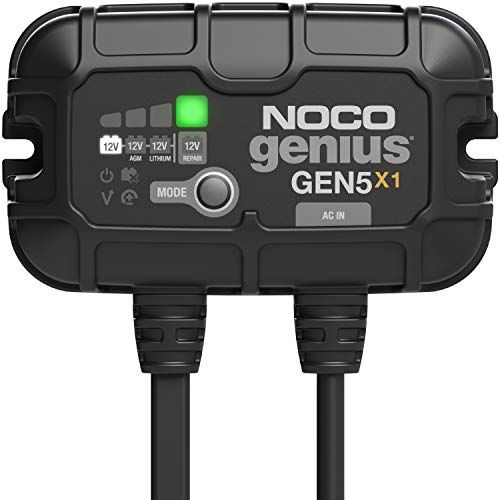
The GEN5X1 is best for compact installations or boats with a single battery bank. It delivers 5A into one bank and supports 12V, AGM, Lithium, and Repair modes. Its small footprint makes it easy to mount under the console or near the battery compartment. Choose this if space is at a premium and you only require a single-charger solution for one bank. A limitation is the lack of additional banks for larger systems.
NOCO Genius GEN5X3: 3-Bank, 15A Onboard Battery Charger
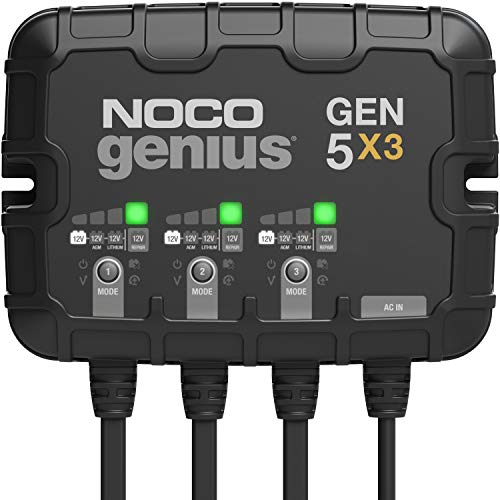
Best for larger boats with multiple batteries requiring dedicated charging paths. The GEN5X3 offers 5A per bank across three banks (15A total) and supports various modes for lead-acid and lithium. It is well-suited for boats with separate engine, house, and starting batteries. Avoid this if you only need one or two banks and want a simpler setup.
NOCO GENIUS2D: 2A Onboard Battery Maintainer
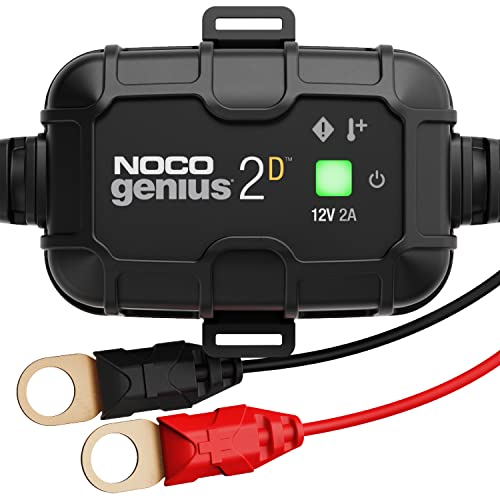
Best for vehicles requiring a continuous maintenance solution rather than high-speed charging. The GENIUS2D is a direct-mount onboard charger and maintainer with 2A output, designed for lead-acid batteries and compatible with AGM, flooded, and deep-cycle types. It doubles as a trickle charger and desulfator, suitable where a compact, permanent installation is preferred. It may be too slow for larger or multiple-bank systems.
Smart 2 Bank Marine Charger, 10A

Best for customers needing a robust waterproof two-bank solution with flexible charging modes. This charger supports 12V SLA/AGM, Lithium, and Calcium modes, with independent bank control and a dedicated dead-battery recovery feature. It’s suitable for boats operating in wet conditions or saltwater environments. A limitation is that user experience can vary with mode selection complexity on some setups.
Buying Guide
Key considerations when choosing an onboard boat battery charger include bank count, total current, and battery chemistry support. If you operate multiple batteries or separate systems (engine, house, starting), a multi-bank charger like 2- or 3-bank models can simplify maintenance. For lithium compatibility, confirm the charger supports 12V Lithium/LiFePO4 and does not default to only lead-acid modes.
- Bank count: Assess how many separate battery groups you maintain. More banks provide independent charging but require space and wiring attention.
- Amperage per bank: Higher per-bank amperage charges faster but may generate more heat. Match to battery capacity and size.
- Battery chemistry: Verify compatibility with lead-acid, AGM, calcium, and lithium types. Some models offer selectable modes for each bank.
- Waterproof rating: Marine environments demand IP-rated or fully waterproof units to withstand splashes and spray.
- Mounting and installation: Direct-mount designs reduce wiring length. Ensure mounting is secure and corrosion-resistant.
- Recovery features: Look for Repair or dead-battery recovery modes if you frequently encounter discharged cells.
Frequently Asked Questions
- What is the difference between a 2-bank and 3-bank charger?
– A 2-bank charger can independently charge two battery groups, while a 3-bank unit can handle three groups, offering more flexibility for larger boats. - Can these chargers handle lithium batteries?
– Yes, many models support 12V Lithium/LiFePO4 in addition to lead-acid chemistries; check each model’s modes. - Do onboard chargers require professional installation?
– Installation is often straightforward but may require mounting, wiring, and connection to battery banks. Follow the manufacturer’s guidelines. - Are there maintenance-oriented chargers suitable for long-term storage?
– Some models include trickle/float maintenance modes that help keep batteries at optimal voltage during storage. - Is waterproof rating essential for a boat charger?
– For exposed installations or high-moisture areas, a waterproof or IP-rated charger is recommended.