Answering the need for reliable marine signaling, this guide highlights five top signal flare options for boats. It explains who each product is best for, why it stands out, and any limitations. Ideal for boaters seeking Coast Guard compliant or electronic alternatives, these picks cover handheld, launcher-based, and electronic distress signaling to improve safety at sea. The buyer’s table below compares core traits to aid quick decisions.
| Product | Best For | Key Benefit | Limitations |
|---|---|---|---|
| Sirius Signal C-1003 SOS LED Distress Signal | Coast Guard- or professional-grade signaling | USCG approved, 60-hour signal, up to 10 nm visibility | Batteries included but non-replaceable beyond kit life |
| Orion Safety 584 ALERTER Basic 12 GA 4-Flares | Traditional flare users needing aerial visibility | High brightness, up to 500 ft altitude, 7-second burn | Requires 12-gauge launcher and storage guidance |
| TEKTITE SOSeFLARE 5 | Electronic distress signaling with audible alert | 30+ hours battery life, waterproof and floats upright | CR123 batteries; replacement logistics matter |
| Caikieme 3 PCS Boat Flares | Affordability and triple-pack for backup | Upgraded electronic signals, Coast Guard certified | Battery availability not specified |
| COASTAL ALERT LAUNCHER KIT | Comprehensive kit with multiple red aerial signals | USCG approved for day and night signaling | Includes 6 signals and whistle; storage guidance |
Sirius Signal C-1003 SOS LED Distress Signal
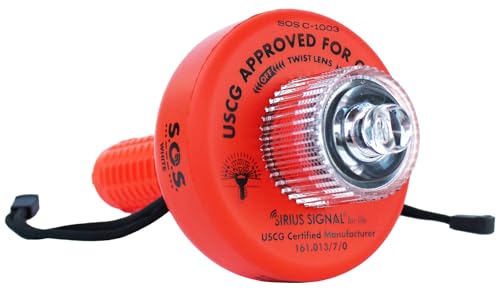
The Sirius C-1003 is a complete Coast Guard approved distress kit designed for quick, one-handed use. It delivers USCG night, day, and audible signaling requirements in a single, battery-powered unit. This option is best for boaters who want a self-contained device that covers multiple signaling modalities and is readily deployable during emergencies.
- Best for: Boats requiring a ready-to-use electronic distress signal with Coast Guard compliance.
- Why selected: Long-lasting, bright SOS signal visible up to 10 nautical miles; up to 60 hours of operation per the USCG spec.
- Caution: Batteries are included but built for long-term readiness; replacement planning should be considered as the kit ages.
Orion Safety 584 ALERTER Basic 12 GA 4-Flares

This option uses traditional aerial flares fired from a 12-gauge launcher. It includes a bandolier for six signals and emphasizes corrosion resistance for marine use. An ORION safety manual provides essential handling and storage guidance. The kit is suitable for anglers, sailboats, and vessels that rely on classic flare signaling for emergency alerts.
- Best for: Boaters who prefer familiar aerial flares with a sturdy launcher system.
- Why selected: Strong altitude and brightness (up to 500 feet and 16,000 candela) help ensure visibility in open water.
- Caution: Requires careful handling and adherence to storage and disposal guidelines for old flares.
TEKTITE SOSeFLARE 5 No More Flares

The TEKTITE SOSeFLARE 5 is an electronic distress signal kit that includes a flag and audible locator, designed to meet USCG and SOLAS standards. It uses CR123 lithium power and can operate for 30+ hours, offering long-life performance and easy maintenance. The device floats upright and remains submersible to great depths, making it a strong choice for watercraft in variable conditions.
- Best for: Boaters wanting a reliable electronic alternative with daytime visibility and audible signaling.
- Why selected: Lightweight, waterproof, and capable of floating upright, with extended battery life.
- Caution: Battery replacement is required to maintain long-term readiness; plan for battery availability.
Caikieme 3 PCS Boat Flares

This three-pack focuses on electronic marine signals with improved reliability and Coast Guard certification. The upgraded design promises stronger signaling across various maritime distress scenarios and is suited for small to mid-sized vessels seeking budget-friendly redundancy. The set is practical for stocking safety kits and backup signaling.
- Best for: Budget-minded boaters needing multiple devices for redundancy.
- Why selected: Coast Guard certified and designed for reliable electronic signaling in diverse conditions.
- Caution: Exact battery details are not specified; consider having spare batteries on hand.
COASTAL ALERT LAUNCHER KIT

The Coastal Alert Launcher Kit provides a comprehensive signaling solution with six high-performance red aerial signals and a SOLAS-approved whistle. This kit is well-suited for boaters who want a robust multi-signal setup for day and night emergencies. It emphasizes Coast Guard approval and includes audible signaling to improve situational awareness during distress scenarios.
- Best for: Vessels needing multiple aerial signals and a clear day/night signaling option.
- Why selected: USCG-approved for both day and night signaling, with an audible whistle for added attention.
- Caution: Proper storage and handling guidelines are essential to maintain readiness and safety.
Buying Guide: Key Considerations For Choosing Boat Signal Flares
- Coast Guard compliance: Look for USCG approval or SOLAS compatibility. This ensures signals meet maritime safety standards and can be relied upon in emergencies.
- Signal type and visibility: Choose electronic distress signals for reusable, daytime and nighttime visibility, or aerial flares for bright, high-altitude signaling. Consider how far you need signals to be visible in open water.
- Power source and maintenance: Electronic signals require battery management and potential replacements; aerial flares depend on cartridge reserves and safe disposal.
- Durability and water exposure: Marine environments demand waterproof, corrosion-resistant enclosures and floatation when applicable. Check buoyancy and submersion ratings.
- Storage and handling: Proper storage conditions, expiration timelines, and handling instructions affect readiness. Include a maintenance plan in your safety kit.
- Installation and use: Some options require launchers or mounting considerations; ensure you have the proper mounting hardware and training for safe deployment.
- Redundancy and kits: For critical safety, consider having both electronic signals and traditional flares as backups to cover varied scenarios and weather conditions.
FAQ: Quick Answers For Boat Signal Flares
- What signals are legally required on most boats?
Coast Guard regulations vary by vessel type and operation area. Many recreational boats use a mix of Coast Guard-approved flares or electronic distress signals as part of standard safety gear. Always check local requirements for your boating license and route.
- How long do electronic distress signals typically last?
Electronic devices can run for 30+ hours on rechargeable or replaceable batteries, depending on model and usage. Planning for battery availability is essential for long trips.
- Can I substitute electronic signals for traditional flares?
Yes, many electronic signals meet regulatory requirements and offer reusable signaling. However, some regions still require traditional flares for certain vessels or conditions, so verify local rules.
- Which signal should I keep as a backup?
A combination approach is prudent: an electronic distress signal for day/night visibility plus a set of traditional flares as a backup in case of battery failure or device damage.
- What maintenance is needed for flare kits?
Regular inspection for corrosion, battery status, seal integrity, and expiration dates is essential. Store in a dry, accessible location and replace spent or outdated devices promptly.