Answer: For buyers seeking reliable propulsion, the best outboard motor power packs provide a balance of power, fuel efficiency, and durability. This guide highlights five top options suited for different boat sizes and uses, from high-horsepower coastal cruising to compact inflatable boats. Each product is evaluated for best-for scenarios, practical limitations, and what to consider before purchasing.
| Product | Horsepower | Fuel Type | Best For |
|---|---|---|---|
| COFECO Hangkai 18HP Outboard | 18 HP | Gasoline | Medium to larger small boats, coastal cruising |
| COFECO 6.5 HP 4-Stroke | 6.5 HP | Gasoline | Small boats, lightweight loading, economical operation |
| BJTDLLX Short Shaft 12 HP | 12 HP | Gasoline | Inflatables and small crafts needing reliable power |
| YIYIBYUS 2.3HP 2-Stroke | 2.3 HP | Gasoline | Tenders, kayaks, compact inflatable boats |
| 4-Stroke 7.5HP Outboard | 7.5 HP | Gasoline | Small boats, easy handling, versatile use |
The following sections provide detailed, objective information for each model. Use the comparison notes to pick the best option for your boat size, typical water conditions, and budget preferences.
COFECO Hangkai 18HP Outboard Motor

Best for: Medium to larger small boats that require higher thrust and faster response. This 18 HP two-stroke engine delivers up to 13.2 kW and reaches 5500 rpm, with an 8″ three-bladed propeller designed to reduce water resistance and maximize power. The CDI ignition provides quick starts, while the water-cooling system maintains optimal temperatures and includes overheating protection. A fuel-efficient design uses a 6.34-gallon external tank and a high-efficiency carburetor, consuming around 1.18 gallons per hour.
Limitations: As a two-stroke design, it may require more regular maintenance and oil mixing depending on model specifics. Best for owners comfortable with higher-maintenance engines and regular servicing routines.
COFECO Outboard Motor, 6.5 HP 4-Stroke
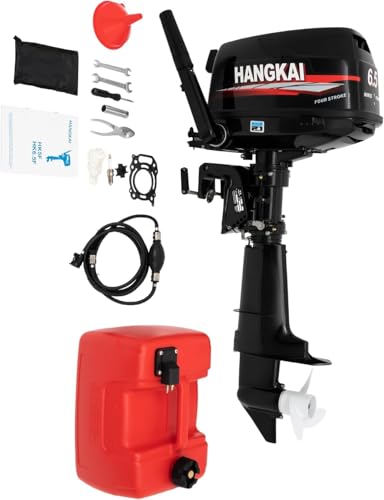
Best for: Small boats needing economical and reliable power with easier maintenance. This 4-stroke, 6.5 HP engine provides up to 4.8 kW, CDI ignition, and a water-cooling system. It is designed for steady operation with relatively low fuel consumption, quoted as about 0.52 gal/hour in typical use. Manuals indicate straightforward starting and solid basic performance for casual boating or light fishing.
Limitations: Lower horsepower means it may be less capable in choppy conditions or when a faster acceleration is needed for larger crafts.
BJTDLLX Short Shaft 12 HP Outboard

Best for: Small to mid-sized inflatables and light craft needing reliable power with versatile control. The 12 HP two-stroke engine offers up to 661-1763 pounds of thrust and speeds from 8-30 km/h. It uses water cooling and features a vent design to extend engine life. Three forward speeds plus neutral and reverse provide flexible cruising options.
Limitations: Heavier and louder than some higher-efficiency four-stroke models, and two-stroke maintenance considerations apply. Assembly and mounting may require basic mechanical skills.
YIYIBYUS 2.3HP 2-Stroke Outboard

Best for: Tenders, small dinghies, and inflatable boats requiring compact propulsion with decent speed. This 2.3 HP, 52cc engine delivers 1.7 kW with a 70 cm shaft and non-contact electronic ignition. Its high efficiency comes from a suitable balance of power and light weight, suitable for occasional use and easy maneuvering.
Limitations: Low horsepower means limited thrust for heavier vessels or strong currents; best used on very light crafts and calm water.
KTYHNPM 4-Stroke 7.5HP Outboard

Best for: Versatile small boats requiring a balance of power and reliability. This 7.5 HP four-stroke engine offers up to 3.5 kW of power, with a CDI ignition and air-cooled design. Its stable, CVT-like behavior in shifting aids smooth operation, while multiple cooling vents help manage heat during longer runs.
Limitation: Four-stroke engines can be heavier than two-stroke options and may have higher upfront costs, though they tend to offer easier maintenance and smoother idle.
Buying Guide: Key Considerations for Outboard Power Packs
- Boat type and size: Match horsepower to the vessel’s weight and intended use. Heavier boats benefit from higher HP, while inflatables and tenders may do well with smaller engines.
- Fuel system and consumption: Consider fuel capacity and planned running time. Two-stroke engines typically offer higher power-to-weight but may require more frequent oil mixing and maintenance; four-stroke engines are usually more fuel-efficient and cleaner-running.
- Fuel efficiency and range: Look for engines with efficient carburetion and CDI ignition for quick starts and smooth operation. Longer trips require larger fuel tanks or higher-efficiency designs.
- Cooling system: Water cooling is standard, with overheating protection. Ensure the motor’s cooling configuration suits your boat’s mounting and operating conditions.
- Starting mechanism: CDI ignition is common for quick starts. Manual pull start is simple but may be harder in adverse conditions; electric starts are not described in these models.
- Durability and materials: Aluminum constructions resist corrosion, particularly important in saltwater use. Venting and heat dissipation features can extend engine life.
- Maintenance considerations: Two-stroke engines generally require more maintenance than four-stroke. Check local service availability and parts compatibility for spare components.
- Installation and compatibility: Confirm shaft length (short vs. long shaft) and mounting pattern with your boat transom. Proper alignment reduces vibration and wear.
Frequently Asked Questions
- What is the best outboard motor power pack for a small inflatable boat?
– A smaller displacement motor like the 2.3 HP or 6.5 HP four-stroke often provides reliable performance with easier maintenance on small inflatables. - Do two-stroke engines offer more power than four-stroke engines at the same size?
– Typically, yes, two-stroke engines can deliver higher power-to-weight, but they may require more maintenance and oil mixing. - Is a longer shaft better for stability?
– A longer shaft helps with deeper water clearance and better trim control on larger, higher-gunwale boats; ensure your boat’s transom is compatible. - What fuel economy should I expect from these motors?
– Four-stroke models generally achieve better fuel efficiency; exact consumption depends on load, RPM, and operating conditions. - Can I mix and match engines with different props?
– Prop selection matters for thrust and efficiency; ensure prop pitch and diameter suit the engine and vessel for best performance.