Answering the common buyer question: which 12-volt electrical panel best protects and organizes circuits on boats, trucks, RVs, and ATVs? The top picks below are compact, corrosion-resistant, and designed to simplify wiring while clearly indicating faults. They’re suitable for DIY wiring projects, mobile setups, and marine/automotive applications. The buyer profiles vary: seasoned installers may prioritize higher amperage capacity and tidy wiring; casual users may want pre-wired convenience and visible LED indicators.
The following table highlights five strong options, showing what each is best for, its key strengths, and any notable limitations to consider at a glance.
| Product | Best For | Key Strengths | Limitations to Know |
|---|---|---|---|
| WUPP 12 Volt Fuse Block (6 Circuits) | Organized, compact 6-circuit setups | LED indicators, neat ground bus, corrosion-resistant | Lower circuit count; 100A panel rating |
| Nilight 5-Gang Multi-Function | All-in-one control panel | Digital voltmeter, dual USB, multiple protections | Pre-wired design; may be larger than single-purpose blocks |
| Cyrico 12 Circuits Fuse Block | Budget-conscious, neat wiring | LED indicators, 12 circuits, 100A total | Basic features; no pre-wired harness |
| DaierTek 12 Way Fuse Block | Rugged, marine-ready applications | LED indicator, tight wiring layout, 12 circuits | Requires proper mounting for splash protection |
| Snlazp 12 Volt Fuse Block | Outdoor or marine uses | PBT housing, 12 circuits, clear labeling | Similar to other 12-circuit panels; check water exposure |
Note: This article focuses on 12V/24V DC panels and fuse blocks that support ATC/ATO style fuses, with a typical 100A panel rating and 12–14 individual circuits. Each product below includes a brief overview, who it’s best for, and a practical caveat to guide your selection.
WUPP 12 Volt Fuse Block: 6 Circuits
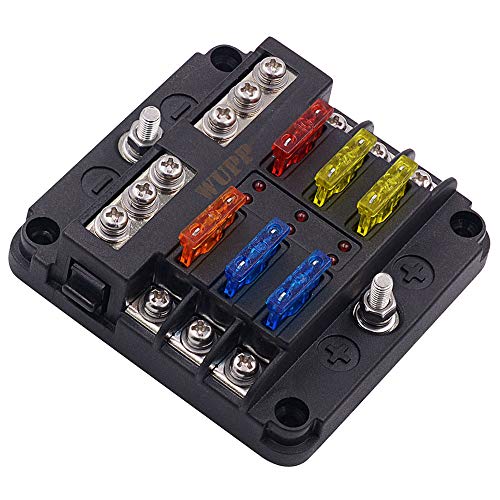
This six-circuit fuse block is designed for compact, organized junctions in boats, cars, or RVs. It includes a negative bus and six dedicated fuses, with LED indicators for quick fault identification. The device is built with nickel-plated copper bus bars for corrosion resistance.
Best for: DIY installers who need a small, organized panel with clear fault signaling and straightforward wiring. It suits projects where space is limited and six circuits cover essential accessories.
Why selected: It emphasizes neat wiring with a dedicated ground bus and built-in LEDs, helping identify blown fuses quickly.
Caution: Some voltage may be present across a circuit even when a fuse is not active due to the panel’s own lighting circuit.
WUPP Boat Marine Fuse Block Panel: 12 Circuits
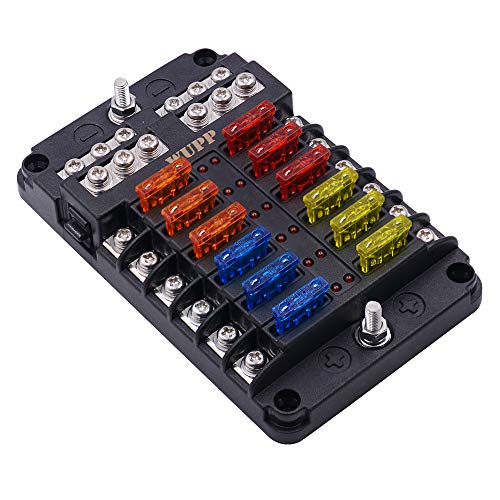
This 12-circuit panel provides 12 fuses and 12 ground points, aiming to keep wiring clean and accessible. It features a red LED warning for blown fuses, and uses durable, flame-resistant materials suitable for marine and automotive environments.
Best for: Boat owners and automotive hobbyists who need a larger, well-organized block with clear fault notification and robust construction.
Why selected: The dual focus on neat wiring and visible fault signaling improves maintainability in outdoor or wet areas.
Caution: Material is designed for 12–24V systems; ensure compatibility with your vehicle’s fuse ratings before installation.
Cyrico 12 Circuits Fuse Block

This 12-circuit block offers LED indicators, a neat wiring layout, and a 100A panel capacity. It is designed for reliable protection of multiple circuits in automotive, marine, or RV setups using ATC/ATO fuses.
Best for: Budget-conscious buyers who want a straightforward 12-circuit solution with clear fault signaling and robust insulation.
Why selected: It balances cost with practical features like dedicated circuit slots and LED indicators for easier troubleshooting.
Caution: It does not include a full pre-wired harness, so some wiring expertise is helpful during install.
DaierTek 12 Way Fuse Block

DaierTek’s 12-way panel combines a compact footprint with LED fault indication and a 100A panel rating. Its design emphasizes clean wiring layouts and protection for multiple devices in marine or automotive settings.
Best for: Users who need a rugged, mid-sized panel that fits into tighter spaces while still providing 12 independent circuits.
Why selected: It’s well-suited for outdoor environments where reliable LED indicators help locate faults quickly.
Caution: Mounting and sealing must be appropriate for splash-prone areas to maintain longevity in marine exposure.
Snlazp 12 Volt Fuse Block

The Snlazp 12-circuit panel uses ATC/ATO fuses with a positive and negative layout, rated up to 32V DC and 100A per panel. It includes DIY stickers for circuit labeling and is designed for outdoor troubleshooting and repairs.
Best for: Outdoor enthusiasts and boat owners who want adjustable labeling for quick servicing in various environments.
Why selected: The included labeling stickers help maintain organized, easily identifiable circuits over time.
Caution: Ensure the weather exposure is within the panel’s protection rating to prevent corrosion or short-circuit risk.
Buying Guide: Key Considerations For 12V Fuse Blocks And Panels
- Number of circuits: Match the panel to your current needs, with room to grow. Common sizes range from 6 to 12 circuits.
- Protection and ratings: Check per-circuit amperage (often 30A) and total panel capacity (commonly 100A). Consider voltage range (32V DC max in many units).
- Indicators and labeling: LED indicators help identify blown fuses quickly. Look for labeling options to simplify future maintenance.
- Wiring organization: A ground bus, separate circuit slots, and neat wiring designs reduce clutter and wiring errors.
- Materials and durability: For marine or outdoor use, select flame-retardant, corrosion-resistant housings—ideally PBT or similar materials—and splash protection.
- Compatibility: Ensure fuses (ATC/ATO), connections, and mounting fit your vehicle, boat, or RV’s electrical system.
- Installation considerations: Determine whether a pre-wired harness is included and whether you need additional mounting hardware or enclosure protection.
FAQ
- Q: What is the typical amperage per circuit for these panels? A: Many panels use 30A per circuit, with a common 100A maximum per panel.
- Q: Do all panels include fuses? A: Some include fuses and LED indicators; others may require you to source fuses separately.
- Q: Are these panels suitable for marine use? A: Many are designed for 12V–24V systems and weather-exposed environments; verify IP splash protection and mounting options for marine use.
- Q: How is wiring organized on these panels? A: Most provide a dedicated ground/bus, multiple circuit slots, and labeling options to keep wiring tidy.
- Q: Do LED indicators indicate only a blown fuse? A: In many models, LEDs illuminate for blown fuses and may also indicate normal circuit status in some designs.
- Q: Can I install these DIY without professional help? A: If you’re comfortable with basic 12V wiring, fuse sizing, and fuse block installation, DIY is feasible; consult manufacturer instructions for specifics.