Answering the core buyer question: which fuel filter should you choose for a boat? This guide highlights five top options, suitable for various engines and setups, including outboards and inboards. It targets boaters who want reliable filtration, visible maintenance indicators, and easy compatibility with common fuel lines. The listed products are best for: casual weekend sailors, performance-minded anglers, diesel and gasoline engines, and DIYers who value straightforward installation and clear maintenance cues.
| Product | Brand | Fuel Type | Key Benefit |
|---|---|---|---|
| Attwood 12562-6 Universal 40-Micron | Attwood | Gasoline | Clear body for visual inspection and rugged construction |
| Quicksilver 802893Q01 Water Separating | Quicksilver | Gasoline | 25 micron filtration for water and particulates |
| CARMOCAR Fuel Filter Water Separator | CARMOCAR | Gasoline | 10 micron filtration with 3/8 NPT ports |
| Quicksilver 879885Q Inline Filter | Quicksilver | Gasoline | Translucent body shows fuel content and debris |
| T-H Marine Universal Fuel Filter | T-H Marine | Gasoline | Transparent glass housing and multiple fitting sizes |
The following sections break down each product with a concise feature-accurate summary, who it’s best for, and practical considerations. Use these cues to compare installation needs, maintenance intervals, and compatibility with your engine type.
Attwood Universal 40-Micron Fuel Filter

Features include a clear, visual body for straightforward maintenance checks, high-strength construction to endure tough marine environments, and a disposable design for convenient replacement. Best for boaters who want quick visual confirmation of fuel health and a simple change-out routine. Caution: as a disposable unit, expect periodic replacement rather than long-term reuse. Ideal for boats with straightforward fuel-line layouts and primary filtration needs.
Quicksilver Water Separating Filter
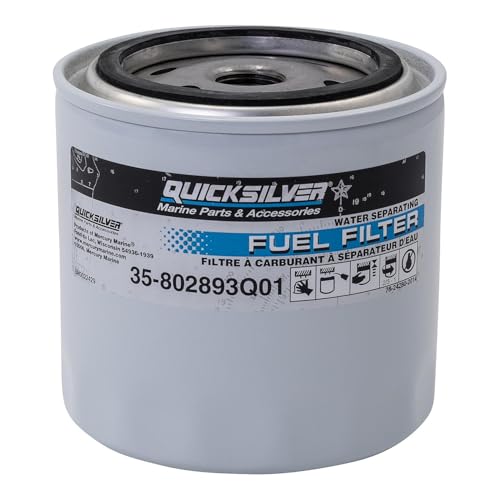
Best for engines that require protection from both fuel contaminants and water. The 25-micron element removes damaging contaminants while the design aligns with Mercury Marine specifications. This filter is well-suited for Mercury and Mariner outboards, MerCruiser sterndrive, and similar systems. Limitation: higher micron filtration may require more frequent replacement if fuel contains heavier contaminant loads.
CARMOCAR 10-Micron Fuel Water Separator

Best for a broad universal fit with 3/8″ NPT ports and 10-micron filtration. It’s marketed as a versatile replacement matching multiple Mercury and Yamaha part numbers, making it a practical choice for mixed-fleet boats. Caution: verify exact port sizes on your current system to ensure compatibility. This model emphasizes small-particulate and water separation efficiency for cleaner fuel delivery.
Quicksilver Inline 879885Q Filter

Best for under-cowl installation with 20-micron capacity. The translucent body enables quick fuel content checks, and it is designed to replace existing clamps without extra hardware. Choose this if you want a compact inline option that makes maintenance visible and simple. Limitation: slightly coarser filtration compared to finer micron options, so more susceptible to small contaminant passage in very dirty fuel.
T-H Marine Universal Filter

Best for versatility across engines due to 1/4″, 5/16″, and 3/8″ fittings and a transparent housing for ongoing monitoring. It suits inboard, outboard, and dual-mource setups, offering easy adaptation to different fuel-line diameters. Caution: glass housing requires careful handling to prevent breakage in rough conditions. This filter excels where archival compatibility and monitoring are priorities.
Buying Guide
How to pick the right fuel filter for your boat and engine. Consider the following practical factors to guide your choice.
What engine type and setup do you have?
Outboard, inboard, or inboard/outboard configurations affect filter size, connection types, and mounting. Choose a model with compatible ports (3/8″, 1/4″, or 5/16″) and mounting flexibility to fit your system without adapters.
What micron rating do you need?
Lower micron numbers (e.g., 10-20 microns) remove finer particles but may require more frequent changes. Higher micron ratings reduce maintenance frequency but can allow smaller contaminants through. Match micron rating to expected fuel quality and engine sensitivity.
Is water separation a priority?
Filters with dedicated water separation protect injectors and pumps from emulsified water. If your fuel source is variable or you store fuel for long periods, prioritize water-separating capabilities and clear observation ports.
How important is visibility and maintenance ease?
Transparent housings or translucent bodies help you gauge fuel condition at a glance. For DIY enthusiasts, easy replacement hardware and accessible clamps simplify routine service.
What are the installation constraints?
Consider available space under the engine cowl, the proximity to fuel tanks, and whether you need inline versus inline-with-view designs. Flexible fittings and universal port options improve compatibility with a broader range of boats.
What are durability and material considerations?
Rugged bodies and corrosion-resistant components extend service life in saltwater environments. Glass housings offer visibility but require careful handling; plastic housings are durable and shatter-resistant but may scratch over time.
Maintenance schedule and replacement practicality
Map out your maintenance intervals based on fuel quality, usage patterns, and manufacturer guidance. Disposable units simplify replacement, while serviceable designs can reduce waste over time.
FAQ
- What micron rating is best for most gasoline engines?
- Do water-separating filters really help in boats?
- Is a transparent housing necessary?
- Should I replace filters with the same part number as OEM?
- Can I install a fuel filter under the dash or inside the engine bay?
- Are there risks with DIY installation?
Common options range from 10 to 25 microns. A 10-micron filter provides finer protection but may require more frequent changes; 20-25 microns offer balanced performance for typical marine fuels.
Yes. They reduce water content in the fuel, which protects injectors and prevents phase separation that can cause engine issues.
Not strictly, but it helps with quick visual checks. Some boats prioritize durability with opaque housings.
Using compatible replacements that meet or exceed OEM specs is recommended. Verify port sizes and thread types before installation.
Yes, as long as the installation area allows access for maintenance and there is sufficient clearance for the filter and hoses.
Ensure correct connections, avoid overtightening clamps, and check for leaks after installation. Improper seals can cause fuel leaks and fire hazards.