If you need reliable VHF marine radios for safety, weather alerts, and clear coast-to-coast communication, you’re in the right place. This guide compares five top options to help you choose the best fit for boaters, sailors, and crew on international waters. Best for commercial skippers, weekend boaters, or anglers, these models cover fixed-mmount units, handhelds, GPS, and Bluetooth features. The following table highlights key details to compare at a glance.
| Product | Type | Power | Special Feature | Best For |
|---|---|---|---|---|
| Uniden UM385 | Fixed Mount | 25 W | DSC, S.A.M.E Weather Alert, International Channels | All-around safety on larger vessels |
| Uniden UM385BK | Fixed Mount | 25 W | DSC, Triple Watch, Weather Alert | Compact, weather-ready boats |
| Cobra MR F77W GPS | Fixed Mount | 25 W | Built-In GPS, Replay Missed Calls | Emergency readiness with location sharing |
| Cobra BlueBound 350 | Handheld | 6 W | IPX7 Waterproof, Floating, NOAA Alerts | Portable radio for small boats or as backup |
| Standard Horizon HX210 | Handheld | 6 W | IPX7 Waterproof, Oscillating Display, Strobe | Simple, rugged handheld for quick use |
Uniden UM385 25 Watt Fixed Mount Marine VHF Radio
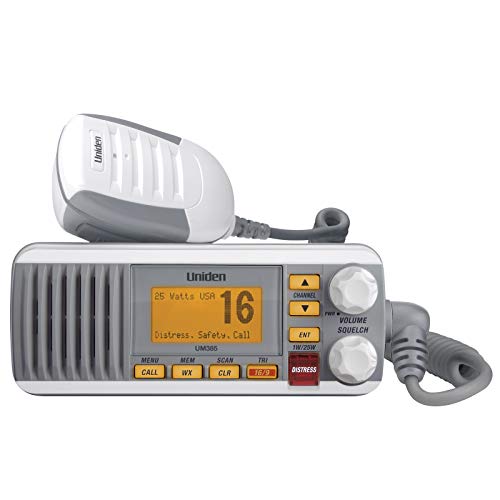
The UM385 combines DSC capability, triple watch, and S.A.M.E. Weather Alert in a compact fixed-mount design. It supports international channels and NOAA alerts, making it a solid choice for boats that regularly travel across borders or into varying weather zones.
Best for: Boats needing robust weather alerts and signaling in a single, space-efficient unit. Better for crews who rely on DSC distress features and international channel access.
Caution: This model’s weather alert and DSC features require proper setup and may need additional accessories to maximize DSC use on some vessels.
Uniden UM385BK 25 Watt Fixed Mount Marine VHF Radio

This black version mirrors the UM385 with triple watch, DSC, and S.A.M.E Weather Alert. It focuses on critical communication during storms or distress scenarios, while offering a sleek, low-profile appearance for modern helm setups.
Best for: Boat owners seeking a visually discreet fixed-mount radio with the same safety and range features as the standard UM385. Choose this if aesthetics or color matching matters on your helm.
Caution: The feature set is similar to the UM385; ensure your installation diagram aligns with vessel wiring and antenna setup.
Cobra MR F77W GPS Fixed Mount VHF Marine Radio
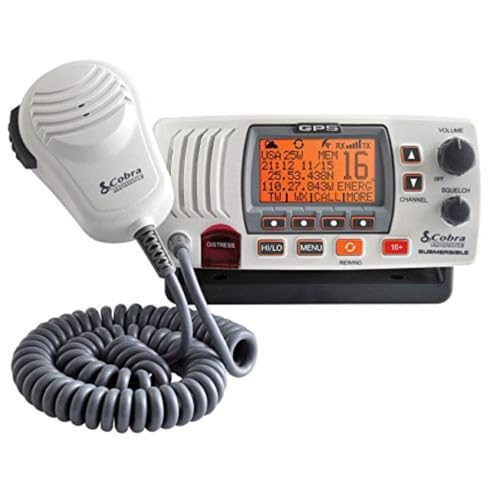
The MR F77W adds a built-in GPS receiver to a 25-watt fixed-mount unit. It supports US, Canada, and international channels, with a replay feature that captures the last 20 seconds of transmissions—helpful for noisy conditions or missed calls.
Best for: Those who want location-based distress signaling and a GPS-backed radio for fleets or offshore trips. Better for skippers who value fast location data in emergencies.
Caution: GPS performance can vary with satellite visibility; ensure mounting location has a clear sky view for accurate readings.
Cobra BlueBound 350 VHF Handheld – Black

Floating and IPX7 waterproof, the BlueBound 350 offers 6-watt output with selectable power settings and a Day/Night LCD display. It’s designed for portability and quick access during on-deck maneuvers or emergencies on small vessels.
Best for: Crew seeking a reliable handheld that stays afloat if dropped and provides NOAA weather alerts. Better for boaters who need a compact, versatile backup radio on deck or in the cabin.
Caution: Handheld performance can be limited by battery life and antenna placement; carry spare batteries for longer trips.
Cobra BlueBound 350 VHF Handheld – White

This variant mirrors the Black BlueBound 350 with identical 6-watt power, floating core, IPX7 waterproofing, and NOAA weather alerts. The white color may improve visibility in certain lighting conditions.
Best for: Boaters who prefer a light, easy-to-spot handheld radio with same reliability and floating capability. Choose this if color preference aids quick identification on deck.
Caution: As with handhelds, battery endurance remains a factor; use USB-C charging efficiently to extend life between charges.
Uniden UM725 Marine VHF Radio

The UM725 includes IPX8 waterproofing, DSC distress features, and NOAA weather channels with alerts. It features a large LCD and supports dual transmit power from 1 to 25 watts, covering US, Canada, and international channels.
Best for: Operators who want a highly capable fixed or portable option with advanced distress features and a large display. Better for longer voyages requiring robust weather information and DSC.
Caution: The larger LCD may require more helm space; ensure your mounting area can accommodate the unit’s footprint.
Uniden UM725GBT Marine VHF Radio

The UM725GBT builds on the UM725 with built-in GPS and Bluetooth. It supports NMEA inputs/outputs for GPS data and DSC, letting you pair with devices or apps for improved navigation and distress signaling. It covers all major channels with 1/25 W power settings.
Best for: Boats that want integrated GPS and Bluetooth for easy pairing with mobile devices or navigation gear. Better for teams using digital accessories and location sharing in emergencies.
Caution: Bluetooth adds power use; plan for battery management on handheld use or during long trips.
Buying Guide: Key Purchase Considerations
- Fixed Mount vs. Handheld: Fixed units typically offer more power and features for a permanent helm setup, while handhelds provide portability and quick access on deck.
- Power Levels: 25 W transceivers offer longer range and clearer transmissions on open water; 6 W handhelds are adequate for local or nearshore use with quick access.
- GPS and DSC: Built-in GPS helps with distress signaling; DSC allows you to send digital distress calls and location data. Consider radios with both for maximum safety.
- Weather Alerts: NOAA weather channels and S.A.M.E. alerts keep crews informed about storms; essential for offshore or storm-prone routes.
- Waterproofing and Submersion Ratings: IPX7 and IPX8 ratings indicate resistance to water immersion; crucial for exposed locations on boats.
- International Channels: If you travel between the US, Canada, and other regions, ensure the radio supports international channels and certification requirements.
- Ease of Use: Large LCDs, user-friendly menus, and simple channel scanning help reduce confusion on the water.
- Accessories: Check included mic, antenna, charger, and compatibility with spare batteries or GPS accessories for handhelds.
Frequently Asked Questions
- What is the difference between UHF and VHF marine radios?
- Do I need NOAA weather alerts on my marine radio?
- Is GPS in a marine radio important?
- What is DSC, and why is it important?
- Can handheld radios replace fixed-mount units?
- What should I consider when choosing a marine radio?
VHF radios operate on the marine VHF spectrum and are the standard for ship-to-ship and ship-to-shshore communication; UHF radios use a different band often found in some fixed deployments but are less common for general boating use. Marine radios under discussion are primarily VHF.
NOAA weather alerts provide timely storm warnings and safety information, which is highly beneficial for coastal and offshore trips.
GPS enables location tagging in distress signals and improves navigation coordination. It’s especially useful for offshore or remote operations.
DSC (Digital Selective Calling) enables digital distress signaling and position sharing, which improves response times during emergencies.
Handhelds are ideal as backups, for crew mobility, or for smaller boats, while fixed-mount radios usually provide power, range, and durability for primary use.
Consider vessel size, typical voyage range, weather exposure, channel requirements, and whether you need GPS, Bluetooth, or NMEA connectivity for navigation integration.