Answering the most common buyer question: which jet-propulsion outboard motor delivers reliable power, quiet operation, and practical versatility? This guide focuses on five top options that balance performance, maintenance, and ease of use for American water enthusiasts. Ideal buyers range from coastal anglers seeking quiet, efficient electric propulsion to island-hopping explorers needing robust gas engines. The quick comparison below helps you choose based on power, fuel type, and intended craft.
| Product | Best For | Power / Type | Key Benefit |
|---|---|---|---|
| Newport NT300 Electric Outboard | Silent anglers and eco-minded boaters | 3HP (1300W) Electric | Long range on a single charge; digital throttle |
| JDCEREN 4HP 4-Stroke | Fiberglass or inflatable craft | 4HP / 55cc Gas | Cruise-friendly, reliable start |
| LIWBYYG 2 Stroke 18HP | Budget-minded power users | 2-Stroke / 18HP | Strong speed with robust build |
| Bixpy K-1 Outboard Kit | Danamic, portable propulsion | 400 W electric motor + battery | Ultra-light, easy to mount |
| NAZEAOB 2 Stroke 18HP | Rugged, load-heavy boats | 2-Stroke / 18HP | High peak power with long shaft |
Newport NT300 Electric Outboard Motor

The Newport NT300 delivers 3HP equivalent propulsion through a 1300W brushless direct-drive system. It offers 110 lb of thrust and is designed for saltwater and freshwater use. This motor emphasizes quiet operation and emissions-free performance, making it suitable for fishing trips and tranquil cruising. The digital throttle with an LCD display supports precise control, while a 24.6″ shaft and a 9.8″ two-blade composite propeller provide balanced handling. Choose this if you want a low-maintenance, reef-friendly option for smaller craft.
Best for: anglers and recreational boaters who value quiet, efficient electric propulsion with extended range on a single charge. Limitation: real-world range varies with boat weight, water conditions, and battery capacity.
Key specs in brief: 66-mile range per charge, top speed about 6.5 MPH, runtime up to 30 hours, trim/tilt options at 0°, 7°, 14°, 21° with 70° max tilt, field-oriented control for smooth operation.
JDCEREN 4HP 4-Stroke Outboard Motor
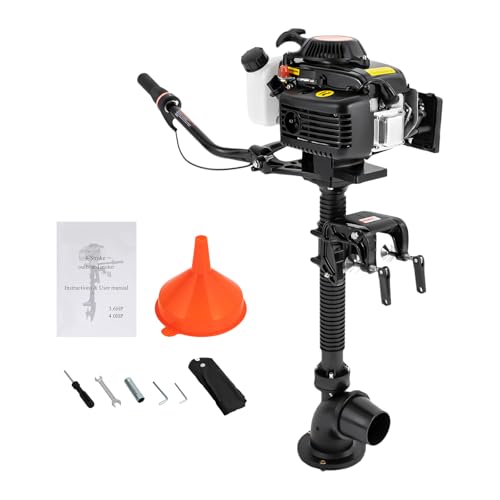
This 4-stroke jet-motor option provides 4HP (55cc) with a 2900W power output and 4500-5500 RPM. The 4-stroke design tends to burn fuel more efficiently and produce cleaner operation than some two-stroke variants. Features include a tilt function, 360-degree rotation, and a CDI ignition system, plus a 180-degree reverse capability via rotation. Best for: small to mid-sized rubber or wooden boats where straightforward ignition and stable idle are priorities. Caution: carburetor quality noted in some listings; expect standard maintenance for optimum starting performance.
Why selected: robust power for calm to moderate water conditions, easy handling, and practical fuel efficiency for longer trips.
LIWBYYG 2 Stroke 18HP Outboard

A 2-stroke engine rated at 18HP, 246cc, and up to 5500 RPM offers strong performance for fast water travel. The motor uses aluminum alloy construction for resilience and corrosion resistance in salt or freshwater. A large muffler helps minimize noise, and a three-blade propeller design aids efficiency. Best for: boaters prioritizing speed and straightforward performance in larger craft. Limitation: two-stroke engines generally require more maintenance and fuel management than modern four-strokes or electric alternatives.
Why selected: excellent power-to-weight ratio and a simple design that suits riders who need swift acceleration and solid reliability on varied water conditions.
Bixpy K-1 Outboard Kit
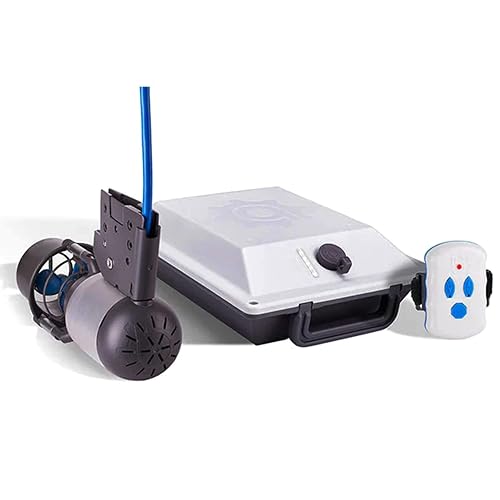
The Bixpy K-1 kit brings a compact electric propulsion solution with a 400 W motor delivering 33 lb of thrust. The total motor and battery weight is about 10 lb, making it highly portable for kayaks, paddle boards, inflatables, and small watercraft. An included battery provides 378 Wh, and cables extend 55 inches for flexible mounting. Best for: ultralight, portable propulsion on small boats or personal watercraft. Caution: battery life depends on load, water conditions, and riding style; heavier use will reduce runtime.
Why selected: exceptional portability and ease of use for travelers who want to add propulsion without significant ballast or system changes.
NAZEAOB 2 Stroke 18HP Outboard

This 2-stroke 18HP outboard uses a 246cc engine with a CDI ignition system and water cooling, designed for long shaft mounting and three gear positions (F-N-R). It emphasizes high power output and corrosion resistance via aluminum alloy construction. Best for: heavier loads and rugged conditions where dependable power is crucial. Limitation: 2-stroke engines typically require more frequent fuel/oil mixing and maintenance than four-stroke models.
Buying Guide: Key Purchase Considerations
- Propulsion Type: Electric motors (quiet and emissions-free) suit calm waters and smaller boats. Gas engines deliver higher raw power for faster planing and heavier loads.
- Power Output: Match horsepower or thrust to boat weight, hull type, and typical loads. Oversized motors add weight and may reduce efficiency on small craft.
- Fuel and Maintenance: Electric options have lower ongoing fuel costs and simpler maintenance. Gas engines require routine checks, carburetor care, and fueling habits.
- Shaf t and Mounting: Ensure shaft length fits transom height and that mounts are compatible with your craft. Long shaft models work better for deeper transoms.
- Durability and Build: Aluminum alloy construction offers corrosion resistance for saltwater use. Consider the environment (saltwater vs. freshwater) when selecting materials.
- Noise and Emissions: Electric motors are significantly quieter and emission-free, ideal for fishing and ecotourism. Gas engines produce more noise and exhaust but offer instant power on demand.
- Range and Runtime: Electric motors depend on battery capacity and efficiency. Plan trips with reserve power in mind to avoid mid-trip shutdowns.
- Ease of Use: Look for digital throttles, easy-start features, and intuitive controls to reduce operator fatigue on longer outings.
Frequently Asked Questions
- What is jet propulsion in outboard motors?
– Jet propulsion uses a high-velocity jet of water to move the vessel, often providing smoother acceleration on small craft and offering good maneuverability in shallow or weed-covered waters. - Are electric outboards as powerful as gasoline ones?
– Electric models provide strong, steady thrust suitable for cruising and trolling, while gas engines typically deliver higher peak power for faster speeds and heavier loads. - What maintenance does a jet outboard need?
– Electric motors require battery care and routine component checks, while gas engines need spark plug servicing, carburetor maintenance, lubrication, and fuel management. - Can I retrofit my boat with any of these motors?
– Retrofitability depends on transom height, shaft length, mounting hardware, and the boat’s electrical system; consult compatibility guides or a pro if unsure. - Which option is best for a quiet fishing trip?
– Electric options, particularly models with efficient throttling and low noise, are generally preferable for quiet environments and wildlife-friendly boating. - Is a longer shaft better?
– Yes, if your transom height requires it. A longer shaft helps prevent prop strikes and ensures optimal propeller immersion in choppy water.